
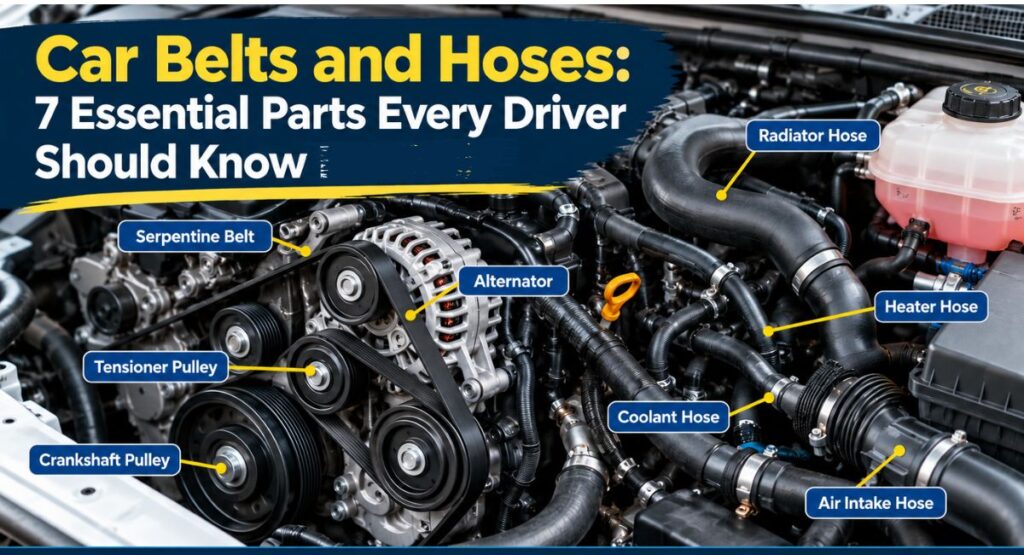
A tow truck driver once told me that a huge share of his summer callouts came down to the same two words: “a hose.” Not an engine, not a transmission — just a length of rubber, usually costing less than $40, that finally gave out after years of quietly doing its job unnoticed. “People know to check their oil,” he said, “but nobody pops the hood looking for a hose.”
That’s exactly the gap this guide is here to close. Your engine bay is full of belts and hoses working constantly, mostly out of sight, and mostly forgotten until one fails. This article walks through the seven essential parts every driver should be able to recognize, what each one actually does, and the warning signs that mean it’s time for a look. For the two belts covered briefly here, we’ve got much deeper dedicated guides linked throughout; the hoses get their full due right in this article.
1. The Timing Belt
The timing belt keeps your engine’s crankshaft and camshaft rotating in perfect sync, controlling exactly when each cylinder’s valves open and close. On the majority of modern engines — called interference engines — a broken timing belt can cause the pistons and valves to collide, leading to serious internal damage. It’s typically replaced every 60,000 to 100,000 miles, or 5 to 10 years.
This is genuinely one of the highest-stakes parts on this entire list, so we’ve given it its own dedicated series: Timing Belt Explained: What Is a Timing Belt and What Does It Do? covers the mechanics, When to Change a Timing Belt? 7 Essential Signs & Replacement Tips covers the warning signs, and Timing Belt Replacement Cost in 2026: What Should You Pay? covers real pricing.
2. The Serpentine Belt
The serpentine belt is the single long belt snaking around the outside of your engine, powering the alternator, power steering pump, and air conditioning compressor. Unlike the timing belt, it’s visible and easy to inspect yourself — a five-minute visual and tactile check at every oil change is usually enough to catch trouble early. Typical lifespan runs 50,000 to 100,000 miles.
For a full, hands-on inspection walkthrough — including how to use a belt wear gauge — see Serpentine Belt Inspection: How to Check Your Serpentine Belt for Wear and Damage in 2026.
3. The Upper and Lower Radiator Hoses
These two hoses carry hot coolant from the engine to the radiator (upper hose) and cooled coolant back to the engine (lower hose), forming the core of your cooling system’s circulation. According to AutoZone’s radiator hose guide, there’s no fixed mileage interval, but most hoses last four to five years, or around 60,000 to 90,000 miles, with some lasting a decade or more depending on operating temperature and hose quality.
Step-by-step: How to check your radiator hoses
- Let the engine cool completely — never do this check on a hot engine.
- Squeeze each hose gently along its length, particularly near the clamped ends.
- Feel for softness, sponginess, or a “crunchy” texture — a healthy hose should feel firm but flexible, springing back when released.
- Look for swelling, especially near the clamps, along with any visible cracking or a shiny, oil-soaked appearance.
- Check underneath the car and around the hose ends for any coolant residue or staining.
Anecdote: A colleague once described her lower radiator hose collapsing on the highway as feeling like “the temperature gauge went from normal to red in about ninety seconds.” A hose with a broken internal support spring had folded in on itself under vacuum, cutting off coolant flow entirely — a $25 part that cost her a tow and a very stressful afternoon.
4. The Heater Hoses
Two smaller hoses carry hot coolant to and from your cabin’s heater core, which is what actually produces warm air on a cold morning. They face the same heat and pressure as radiator hoses but are often overlooked since they’re smaller and less visually obvious. A failing heater hose typically shows up as a sweet smell inside the cabin, foggy or oily film on the inside of the windshield, or a heater that’s suddenly blowing cool air despite the engine running warm.
What to do if you notice these signs: Don’t ignore a sweet smell in the cabin — it’s a classic sign of a coolant leak, and depending on where the hose runs, a leak here can also mean coolant dripping onto other components. Get it checked promptly rather than simply cranking the heat higher.
5. The Coolant Reservoir Hose
This smaller hose connects your radiator to the overflow/reservoir tank, allowing coolant to expand and contract safely as it heats and cools. It’s a low-pressure hose compared to the main radiator hoses, but it still fails in similar ways — cracking, disconnecting at a loose clamp, or simply falling off a brittle, aged connector. A telltale sign is a coolant reservoir that never seems to hold the right level, or one that empties out despite no coolant leak elsewhere.
6. The Fuel Line
Fuel lines carry gasoline or diesel from the tank to the engine under real pressure, and unlike coolant hoses, a failure here carries an obvious fire risk alongside the mechanical one. Modern fuel lines are built from reinforced rubber or nylon specifically rated for fuel resistance — never a generic hose, even in an emergency. Warning signs include a strong fuel smell (especially when the engine is off and sitting), visible wet staining along the line, or a fuel gauge that seems to drop faster than your driving would explain.
Why this one deserves extra caution: Because of the fire risk involved, a suspected fuel line issue is never a wait-and-see situation. If you smell fuel and can’t immediately identify an obvious, minor source (like a loose gas cap), it’s worth having it inspected the same day rather than continuing to drive on it.
7. Vacuum Hoses
Modern engines rely on a network of small vacuum hoses to operate everything from the brake booster to various emissions components. These are usually the thinnest, most overlooked hoses in the entire engine bay, and a small crack or a hose that’s simply popped off a fitting can cause a surprisingly wide range of symptoms: a rough idle, a hissing sound from the engine bay, a check engine light, or — most importantly — a noticeably harder brake pedal, since the brake booster relies on vacuum to assist your braking effort.
Step-by-step: Tracking down a vacuum leak
- Listen for a hissing sound near idle, often more noticeable with the hood open and the radio off.
- Check for a rough or fluctuating idle, which is one of the most common vacuum leak symptoms.
- Visually trace any hoses that look disconnected, cracked, or misrouted compared to the engine bay’s diagram.
- If you have access to a scan tool, check for fuel trim codes, which often indicate an unmetered air leak consistent with a vacuum hose issue.
- If the brake pedal feels unusually stiff or hard to press, treat this as a priority rather than a minor annoyance — it directly affects your stopping power.
What Are the 3 Belts in a Car? A Bit of History
If you’ve ever wondered what are the 3 belts in a car, the honest answer depends on the vehicle’s age. Older cars typically ran three separate belts: one for the alternator, one for the power steering pump, and one for the water pump/cooling fan. Each was a distinct loop with its own tensioning adjustment, and losing one meant losing just that single function — power steering could fail while the alternator kept charging, for instance.
Modern vehicles consolidated all of this into the single serpentine belt covered above, which drives all of these accessories from one continuous loop. The tradeoff is important to understand: it’s more efficient and easier to maintain, but if it fails, you typically lose power steering, charging, and cooling all at once, since one belt now does the job that three used to share. If you’re working on an older vehicle with a classic multi-belt setup, each belt still needs its own individual inspection rather than assuming a single check covers everything.
Car Belts and Hoses Replacement Cost: What to Expect
Since pricing varies so much by part, here’s a realistic breakdown of car belts and hoses cost across everything covered in this guide:
| Part | Typical Replacement Cost |
|---|---|
| Timing belt | $500 – $1,500 |
| Serpentine belt (belt only) | $100 – $250 |
| Serpentine belt + tensioner | $200 – $450 |
| Radiator hose (per hose, installed) | $100 – $300 |
| Heater hose (per hose, installed) | $100 – $250 |
| Coolant reservoir hose | $50 – $150 |
| Fuel line (varies significantly by location) | $150 – $400+ |
| Vacuum hose | $20 – $100 |
For car belts and hoses replacement, labor is almost always the larger share of the bill, since reaching many of these parts means removing covers, brackets, or other components first — the same reason a full cooling system hose replacement is often bundled into a single visit rather than done one hose at a time. If you’re budgeting for a broader visit, cost aggregators and shops sometimes cite figures similar to what’s compiled in general repair-cost surveys (the kind AAA and similar organizations publish for common repairs), so it’s worth requesting an itemized quote that separates parts from labor for each specific belt or hose being replaced.
Finding the Right Replacement: Car Hose Replacement and Belt Cross-Reference Tools
Once you know which part needs replacing, finding the exact correct one matters just as much as the diagnosis. For car hose replacement, always match by diameter, length, and pressure rating rather than assuming “close enough” will do — fuel lines and radiator hoses in particular are rated for specific pressures and chemical resistance that a generic hose may not meet.
For belts specifically, a genuinely useful resource is the O’Reilly belt cross reference chart, a real tool on O’Reilly Auto Parts’ site that lets you search by your original part number and see equivalent belts across major brands like Gates, Dayco, and ACDelco. This is particularly handy if your vehicle’s exact OEM part isn’t readily available, since it shows verified equivalents rather than leaving you to guess based on size alone.
Quick Reference: All 7 Parts at a Glance
| Part | Typical Lifespan | Key Warning Sign |
|---|---|---|
| Timing belt | 60,000–100,000 mi / 5–10 yrs | Ticking noise, hard to start |
| Serpentine belt | 50,000–100,000 mi | Squealing, visible cracking/glazing |
| Radiator hoses | 4–5 yrs / 60,000–90,000 mi | Soft/spongy feel, swelling, overheating |
| Heater hoses | Similar to radiator hoses | Sweet smell in cabin, weak heat |
| Reservoir hose | Varies, condition-based | Coolant level drops with no visible leak |
| Fuel line | Varies, condition-based | Fuel smell, visible staining |
| Vacuum hoses | Varies, condition-based | Hissing, rough idle, stiff brake pedal |
Bookmark this table as a starting point, then refer back to each section above for the full detail on what to check and how.
Why These Parts Deserve More Attention Than They Get
Here’s the pattern across every part on this list: they’re cheap on their own, and expensive to ignore. A radiator hose is a $25-$40 part; the overheating and potential engine damage that follows a failure can run into the thousands. A serpentine belt is $25-$75; the simultaneous loss of power steering, charging, and air conditioning it can cause is genuinely dangerous at the wrong moment. As that tow truck driver put it, these parts rarely fail dramatically without warning — they crack, soften, swell, and weep coolant for weeks before they finally let go. A five-minute look under the hood, done regularly, is what catches that window.
Build a Seasonal Habit Around This Checklist
Rather than trying to remember all seven parts individually, it’s easier to build a simple seasonal habit around them. Spring and fall are the two best times to do a full belts-and-hoses check: spring, because winter cold makes rubber brittle and more prone to cracking; fall, because you want everything in good shape before the next round of temperature swings.
A simple seasonal routine:
- Pop the hood with the engine cool and give every visible hose a gentle squeeze test.
- Run your fingers along the serpentine belt’s ribs, checking for cracking or a glazed surface.
- Look underneath the car for any fresh staining or puddles, noting the fluid’s color if you spot one.
- Start the engine and listen for any new hissing, squealing, or ticking sounds before you begin driving for the day.
- Note anything questionable and address it before it becomes a roadside problem rather than a driveway one.
This entire routine takes under ten minutes and catches the overwhelming majority of belt and hose failures well before they turn into the kind of afternoon that tow truck driver spends every summer responding to.
Why It’s Worth Using Quality Replacement Parts
When any of these parts do need replacing, this is genuinely not the place to shop on price alone. Cheap, generic hoses and belts are more prone to premature cracking, swelling, and the exact electrochemical degradation that causes hoses to fail from the inside out while looking fine on the surface. Choosing OEM or reputable OEM-equivalent parts, properly rated for your specific engine’s temperatures and pressures, is one of the smartest small investments you can make in your car’s reliability. Ask your mechanic which brand they’re using and why — a shop that can answer confidently is one that takes this often-overlooked corner of maintenance as seriously as it deserves.
Final Thoughts
Belts and hoses rarely get the attention that oil changes and brake checks do, but they’re just as capable of stranding you on the side of the road — often for the cost of a part smaller than a coffee mug. Learning to recognize these seven components, and giving them a genuine five-minute look every so often, is one of the highest-value habits in this entire guide series.
For the full system-by-system maintenance schedule, see our Complete Guide to Car Maintenance: What to Check and When, and if you’re dealing with a specific engine problem right now, our guide on Vehicle Maintenance Issues: 10 Common Problems and Simple Solutions can help you work through it. As that tow truck driver would tell you: pop the hood, give the hoses a squeeze, and save yourself the afternoon.
Frequently Asked Questions
What are the hoses in a car?
Your car has several rubber (or reinforced rubber/nylon) hoses that carry fluids and air between components under the hood. The main ones are the upper and lower radiator hoses (carrying hot coolant to the radiator and cooled coolant back to the engine), the heater hoses (sending hot coolant to the heater core for cabin warmth), the coolant reservoir hose (connecting the radiator to the overflow tank), the fuel lines (delivering fuel from the tank to the engine), and a network of small vacuum hoses (operating things like the brake booster and emissions components). Depending on the vehicle, you may also have power steering hoses, brake hoses, and air conditioning hoses. Each one is cheap on its own but critical to the system it serves.
What are belts and hoses in a car?
Belts and hoses are the flexible rubber components that keep your engine’s systems connected and running. Belts transfer rotational power: the timing belt synchronizes the crankshaft and camshaft inside the engine, while the serpentine belt (or drive belt) powers external accessories like the alternator, power steering pump, and air conditioning compressor. Hoses carry fluids and air: coolant, fuel, and vacuum. Together they form a large part of your engine bay’s “plumbing and drive system,” and because they’re made of rubber, they wear out from heat, pressure, and age even when they look fine from the outside.
How often should car hoses be replaced?
There’s no single fixed mileage interval, since hose life depends heavily on operating temperature, hose quality, and driving conditions. As a general guideline, most radiator and coolant hoses last roughly four to five years, or around 60,000 to 90,000 miles, though some last a decade or longer. Because hoses often fail from the inside out (a process where internal deterioration isn’t visible externally), regular inspection matters more than sticking rigidly to a mileage number: check hoses at every oil change, and replace any that show swelling, cracking, softness, or leaking regardless of mileage. Many mechanics also recommend replacing the whole set of coolant hoses together once one fails, since the rest are the same age and under the same stress.
How often should hoses and belts be replaced?
The two have quite different schedules, so it helps to separate them:
Timing belt: typically every 60,000 to 100,000 miles, or every 5 to 10 years, whichever comes first, per your manufacturer’s interval. This one is scheduled, not symptom-based.
Serpentine belt: typically every 50,000 to 100,000 miles, depending on whether it’s an older neoprene or newer EPDM belt, inspected at every oil change.
Hoses: condition-based, roughly every 4 to 5 years or 60,000 to 90,000 miles for coolant hoses, replaced sooner if inspection shows swelling, softness, cracking, or leaks.
The safest routine is a quick visual and squeeze inspection of all belts and hoses at every oil change, with the timing belt tracked separately against your owner’s manual interval.
What symptoms indicate a deteriorated hose?
Look for these warning signs, either during a visual inspection or while driving:
Swelling or bulging, especially near the clamped ends
Cracking, splitting, or a “crunchy” feel when squeezed
A soft, spongy, or mushy texture instead of firm but flexible
Coolant residue, staining, or a sweet smell around the hose or under the car
A shiny, oil-soaked appearance, which can indicate contamination degrading the rubber
Frequent coolant loss with no obvious leak elsewhere
Overheating, if a coolant hose is restricting or leaking
A hissing sound or rough idle, which can point to a cracked or disconnected vacuum hose
How to tell if a radiator hose needs replacing?
Do a quick hands-on check with the engine completely cool (never on a hot engine). Squeeze each hose gently along its length, especially near the ends. A healthy hose feels firm but flexible and springs back when released. Replace it if it feels soft or spongy, crunchy, swollen, or if you can see cracking, splitting, or a shiny oil-soaked surface. Also check around the hose ends and underneath the car for coolant staining or drips. One extra warning: a lower radiator hose with a broken internal support spring can collapse inward under vacuum while driving, cutting off coolant flow and causing sudden overheating even if the hose looks fine from the outside.
How much does it cost to replace belts in a car?
Costs vary by belt type. A serpentine belt typically runs $100 to $250 for the belt alone, or $200 to $450 if the tensioner and idler pulleys are replaced at the same time. A timing belt is a much larger job, typically $500 to $1,500 (and up to $2,500 or more on some vehicles), because most of the cost is labor to reach the belt, not the belt itself. Most shops recommend replacing the water pump, tensioner, and idler pulleys alongside a timing belt since the labor is already being paid for.
How much does it cost to replace hoses on a car?
Individual hose replacement is generally more affordable than belts: a radiator hose typically costs $100 to $300 installed per hose, a heater hose about $100 to $250, a coolant reservoir hose roughly $50 to $150, a vacuum hose often just $20 to $100, and a fuel line can range from $150 to $400 or more depending on location and accessibility. The hose itself is usually only $25 to $40, so labor drives most of the price. If several coolant hoses are aging together, having them all replaced in one visit is often more cost-efficient than doing them one at a time.
What are the three belts on my car?
It depends on your car’s age. Older vehicles typically ran three separate belts: one for the alternator, one for the power steering pump, and one for the water pump and cooling fan. Most modern vehicles have consolidated these into a single serpentine belt that powers all those accessories from one continuous loop, plus a separate timing belt (on vehicles that use a belt rather than a timing chain) inside the engine. So on a newer car, you’ll typically find one or two belts rather than three. To know exactly what your car has, check your owner’s manual or search your specific make, model, and engine, since some vehicles use a timing chain instead of a timing belt entirely.