When to change a timing belt is a question a lot of drivers only ask after it’s already too late. A guy I used to carpool with once ignored a faint ticking sound coming from under his hood for almost three weeks. “It’s probably nothing,” he kept saying. One Tuesday morning, the ticking stopped — and so did his engine, right in the middle of an intersection. His timing belt had snapped. What would’ve been an $800 scheduled replacement turned into a $4,200 engine repair, plus a tow, plus a week without a car. He still brings it up, half as a joke and half as a warning to anyone who’ll listen.
That story is precisely the reason this guide needed to be written. The timing belt — called a cam belt in the UK and elsewhere, so if you’ve been searching when to change a cam belt, you’re in the right place — is one of the few components in your car where timing genuinely is everything. Catch it early, and it’s a routine, affordable job. Miss it, and depending on your engine, you could be looking at one of the most expensive repairs a car can need. This article walks through the seven essential warning signs, the actual timing belt replacement interval, how replacement works, and why acting early is worth every penny. If you’d like the bigger picture of how this fits into your overall car care routine, our Complete Guide to Car Maintenance: What to Check and When covers every system in detail.
What Does a Timing Belt Actually Do?
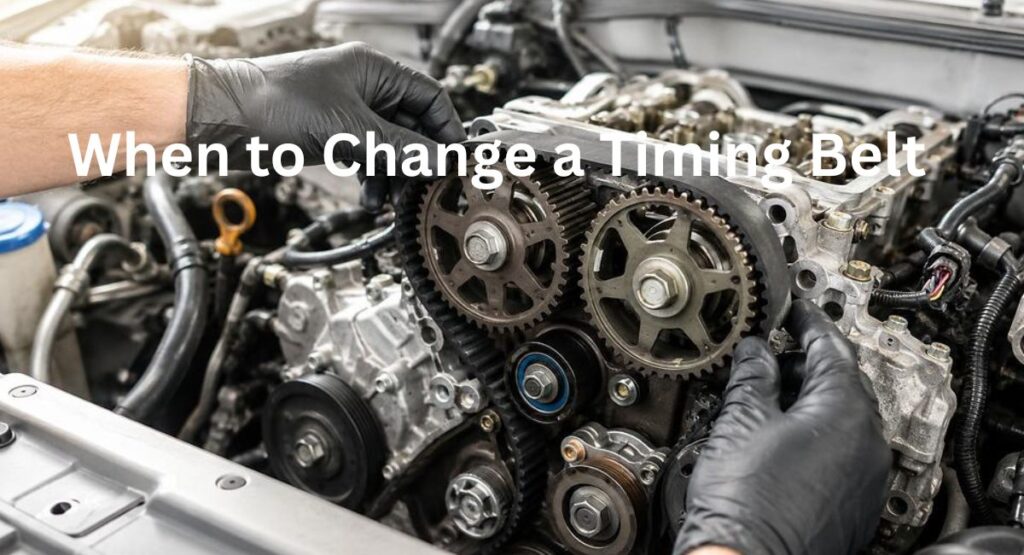
Before diving into the warning signs, it helps to understand what you’re actually protecting. Your timing belt is a reinforced rubber belt that keeps your engine’s crankshaft and camshaft rotating in perfect sync, which controls exactly when each cylinder’s valves open and close relative to the piston’s movement. Think of it as the conductor of your engine’s orchestra — every piston and valve needs to move at precisely the right moment, and the timing belt is what keeps that rhythm locked in.
On many engines — called interference engines — the pistons and valves occupy the same physical space at different points in the engine cycle. As long as the timing belt keeps everything synchronized, that’s never a problem. But if the belt slips or snaps, the pistons and valves can physically collide, bending valves, damaging pistons, and sometimes cracking the cylinder head. According to industry cost data, roughly 90% of modern engines are interference designs, which is exactly why this component deserves more attention than its unglamorous, out-of-sight location under the hood might suggest.
Timing Belt Warning Signs: 7 Important Things to Watch For
1. A Ticking or Clicking Sound Coming from the Engine’s Front End
This is often the very first warning sign, and it’s easy to dismiss because it can start faint and intermittent. This noise usually happens because belt teeth have gone missing or cracked, letting the belt slip slightly against the camshaft or crankshaft sprocket. It tends to worsen under load or at higher RPM. If you hear a new ticking sound from the front of your engine, don’t wait to have it checked.
2. Rough Idling or Engine Misfires
When a worn timing belt starts to slip, it throws off the precise valve timing and piston synchronization. Cylinders begin firing at slightly incorrect intervals, which shows up as a rough, uneven idle, hesitation during acceleration, or a general feeling that the engine isn’t running as smoothly as it used to.
3. Difficulty Starting the Engine
Once the belt has slipped noticeably — or skipped a tooth on the sprocket — your engine might take longer than usual to catch, or refuse to start at all. This happens because correct valve timing is essential for building the compression needed to fire the engine, and a slipped belt disrupts that timing at the exact moment you need it most.
4. A High-Pitched Squealing or Chirping Sound
Unlike the ticking sound (which usually points to the belt itself), a squealing or chirping noise from the timing cover area is often caused by a worn or glazed tensioner pulley or idler pulley rather than the belt. Either way, these components are part of the same system, and this sound is a clear signal that a professional inspection is overdue.
5. The Belt Itself Shows Cracking, Fraying, or a Glazed Look
If your timing belt is visually accessible (this varies by vehicle design), a direct visual inspection is one of the most reliable ways to catch trouble early. Look for cracking, frayed edges, missing teeth, or a shiny, glassy appearance — all clear signs that replacement shouldn’t be delayed, even if the engine still sounds and runs normally.
6. You Notice Oil Leaking Near the Engine’s Front End
An oil leak near the timing cover can actually accelerate belt wear, since oil contamination degrades rubber over time. If you notice oil pooling near the front-center of your engine, it’s worth having both the leak and the belt’s condition checked in the same visit, since one issue can be quietly causing the other.
7. You’ve Reached (or Passed) Your Manufacturer’s Interval
This is the sign most drivers overlook simply because it doesn’t announce itself with a sound or symptom. Timing belts typically need replacement every 60,000 to 100,000 miles, or roughly every 5 to 10 years, depending on your specific vehicle — check your owner’s manual for the exact figure. Timing belts often fail with little to no warning once they’re past their intended service life, which is exactly why mileage should be treated as seriously as any audible symptom.
Step-by-Step: How to Check Where You Stand
Step 1: Find your manufacturer’s timing belt interval. Check your owner’s manual, or search your exact make, model, and year online — intervals vary meaningfully between manufacturers and engine types.
Step 2: Check your mileage against that interval. If you’re within 10,000–15,000 miles of the recommended interval, start planning the replacement now rather than waiting for a symptom.
Step 3: Listen and look for the seven signs above. Even if you’re not yet at the mileage interval, a belt can occasionally wear faster than expected — pay attention to unusual noises or a visual inspection if your engine bay allows it.
Step 4: Ask whether your engine is an interference or non-interference design. A quick search or a call to your mechanic will tell you this, and it changes how urgently you should act — see the next section for why.
Step 5: Book the replacement proactively, not reactively. Once you’re near the interval, schedule the service before a road trip or a busy season, rather than waiting for the belt to make the decision for you.
Timing Belt Replacement Interval: How Often to Change It
So, how often to change timing belt components, exactly? As a general rule, most manufacturers set the timing belt replacement interval at 60,000 to 100,000 miles (roughly 100,000 to 160,000 km), or every 5 to 10 years, whichever comes first. This is the most reliable general answer to how often does a timing belt need to be replaced — though as the next section shows, the exact number varies meaningfully by manufacturer and even by engine within the same model lineup.
A few extra factors affect when does a timing belt need to be replaced for your specific car:
- Severe driving conditions (extreme heat, extreme cold, frequent short trips) can shorten the safe interval — some manufacturers explicitly call for replacement as early as 60,000 miles under these conditions, even if their standard interval is longer.
- A manual transmission tends to be slightly harder on a timing belt than an automatic, due to how engine load is applied.
- Age matters even at low mileage. A belt sitting on a lightly driven car still degrades from heat cycles and time, which is why the “or X years” half of the interval exists alongside the mileage figure.
Timing Belt Replacement Recommendations by Make and Model
Generic advice is a good starting point, but timing belt replacement recommendations by make and model vary enough that it’s worth checking your specific vehicle rather than assuming. Here’s what the most commonly searched examples actually look like:
| Make / Model | Timing System | When to Change It |
|---|---|---|
| When to change a timing belt Toyota | Varies — many newer Toyota engines use a timing chain (lifetime, no scheduled mileage), while some older or V6 models use a belt | Belt-equipped models: typically 90,000–100,000 miles; check your specific engine, since Toyota uses both systems across its lineup |
| When to change a timing belt Honda | Varies by engine — most 4-cylinder Hondas use a timing chain; some V6 Hondas use a belt | Belt-equipped V6 models: typically 105,000 miles or 7 years |
| When to change a timing belt Honda Accord | The Accord’s 4-cylinder engine uses a timing chain (no scheduled replacement); the V6 engine uses a timing belt | V6: 105,000 miles or 7 years, whichever comes first; severe conditions may call for 60,000 miles |
| When to change a timing belt Chevy | Most modern Chevrolet engines use a timing chain rather than a belt | Chains are generally lifetime components; no fixed mileage replacement, but have it inspected if you hear rattling on cold start |
| When to change a timing belt Chevy Silverado | The Silverado’s V8 engines use a timing chain, not a belt | No scheduled replacement under normal use — treat any cold-start rattling noise as a reason for inspection |
The honest takeaway here is genuinely useful: several of the most-searched vehicles on this list — the Accord’s 4-cylinder engine and the Silverado, specifically — don’t use a timing belt at all, so there’s no mileage-based replacement to schedule. If you’re unsure which system your specific engine uses, a quick search of your exact model year and engine size, or a call to your dealer’s parts department, will confirm it in minutes.
Interference vs. Non-Interference Engines: Why It Changes the Stakes
This distinction matters enormously, and it’s worth understanding before you decide how urgently to act.
- Interference engines, which make up the large majority of modern vehicles, have valves and pistons that share the same space at different points in the engine’s cycle. If the belt breaks, the pistons and valves collide — bending valves, damaging pistons, and sometimes cracking the cylinder head.
- Non-interference engines have enough clearance built in that a broken belt simply stops the engine. You’ll need a tow and a new belt, but the internal components typically survive unharmed.
If you don’t know which type your engine is, it’s worth finding out — it directly affects how much risk you’re carrying by delaying replacement.
The Real Cost Comparison: Replace Now vs. Pay Later
The math on this one is about as clear-cut as car maintenance gets. According to multiple industry cost breakdowns, scheduled timing belt replacement typically costs between $500 and $1,300 for most vehicles, including parts and labor. Compare that to what happens if the belt breaks on an interference engine: repair costs commonly range from $3,000 to $7,000 or more, and in some cases, the repair can cost more than the vehicle itself is worth.
| Scenario | Typical Cost |
|---|---|
| Scheduled timing belt replacement | $500 – $1,300 |
| Belt failure on a non-interference engine (tow + new belt) | Similar to scheduled cost, plus towing |
| Belt failure on an interference engine (engine damage) | $3,000 – $7,000+ |
Most shops also recommend replacing the water pump, tensioner, and idler pulleys at the same time as the belt, since labor makes up the majority of the job’s cost — you’re already paying to access these components, so replacing them together avoids paying for that same labor twice down the road.
Timing Belt vs. Timing Chain: Does This Apply to Your Car?
Not every vehicle has a timing belt at all, so it’s worth confirming which system your car actually uses. A timing belt is made of reinforced rubber and requires scheduled replacement, typically every 60,000 to 100,000 miles, because rubber degrades over time and use. A timing chain, on the other hand, is made of metal and is generally designed to last the lifetime of the engine under normal conditions, though it can still stretch or wear over very high mileage. If you’re not sure which one your car has, a quick search of your exact make, model, and engine will tell you — and if you have a timing chain rather than a belt, the seven signs above still apply almost identically, just without a scheduled mileage replacement built in. The most common symptom of a worn timing chain is a rattling or clattering noise from the front of the engine specifically on cold starts, caused by a slack chain slapping against its guide before oil pressure builds up.
Can You Still Drive With a Failing Timing Belt?
Short answer: it’s genuinely risky, and not something to push your luck on. Timing belts rarely fail completely without warning — they usually give you some combination of the seven signs above first. But once you notice ticking, squealing, rough idling, or visible wear, the belt can be anywhere from a few days to a few months away from complete failure, and there’s no reliable way to predict exactly when. Since a break can strike without a moment’s further warning, the smart move is treating any of these symptoms as a “book an appointment this week” matter, not a “deal with it whenever” one — particularly if you don’t know whether your engine has an interference design.
Why It’s Worth Trusting Quality Parts and an Experienced Mechanic for This One
Of every maintenance task in this guide series, timing belt replacement is one where cutting corners genuinely isn’t worth it. This is a labor-intensive, precision job — the belt has to be installed with exact tooth alignment on the crankshaft and camshaft sprockets, or the engine can run poorly or even suffer damage despite the “fix.” Choosing a certified, experienced mechanic and a quality OEM or manufacturer-recommended belt kit (rather than the cheapest option available) gives you real confidence that the job is done correctly the first time. Ask whether the water pump and tensioner are being replaced alongside the belt, and don’t hesitate to ask about the shop’s experience with your specific engine — some engines are notoriously more labor-intensive to access than others, and experience matters here more than almost any other routine service.
Final Thoughts
The timing belt doesn’t ask for much — a check every 60,000 to 100,000 miles, and a little attention to unusual noises in between. What it gives you in return is enormous: the difference between a predictable few-hundred-dollar maintenance bill and a potential engine-replacing catastrophe. If my old carpool buddy had acted on that ticking sound instead of shrugging it off, his story would’ve ended with a receipt instead of a tow truck.
If you’d like to build this into your broader maintenance routine, our guide on How Often Should You Service Your Car? Essential Guide for 2026 can help you plan around major mileage milestones like this one, and our guide to Vehicle Maintenance Issues: 10 Common Problems and Simple Solutions covers other warning signs worth knowing. A little attention to the parts you can’t see is often what keeps the parts you can see running for years to come — and the next time you hear a strange new sound from under the hood, it’s worth remembering that ignoring it rarely makes it go away on its own.
Frequently Asked Questions
How do I tell if my timing belt needs replacing?
There are two ways to know: watching for symptoms, and tracking your mileage against your manufacturer’s interval, and both matter equally. On the symptom side, watch for a ticking or clicking noise from the front of the engine, rough idling or misfires, difficulty starting, a high-pitched squealing near the timing cover, visible cracking or fraying on the belt itself (if it’s accessible for inspection), and oil leaks near the front of the engine. On the mileage side, check your owner’s manual for your specific replacement interval — typically 60,000 to 100,000 miles — and treat reaching that number as seriously as any audible symptom, since timing belts often fail with little to no warning once they’ve passed their intended service life. The safest approach combines both: don’t wait for a symptom if you’re already near the mileage interval, and don’t dismiss a symptom just because you haven’t hit the mileage yet.
What is the average lifespan of a timing belt?
Most timing belts are designed to last between 60,000 and 100,000 miles, or roughly 5 to 10 years, whichever comes first — though the exact figure depends heavily on the manufacturer and specific engine. Older vehicles (generally pre-1998) often used a more conservative 60,000-mile standard, while many newer belts, built with improved materials, can safely reach 90,000 to 100,000 miles. Driving conditions matter too: consistently extreme heat or cold, frequent short trips, and manual transmissions can all shorten a belt’s realistic lifespan compared to the manufacturer’s baseline figure.
How much should it cost to replace a timing belt?
Scheduled timing belt replacement typically costs between $500 and $1,300 for most vehicles, including parts and labor, though costs can run higher — up to $2,000 or more — for luxury vehicles or engines with difficult access. Labor makes up the majority of that cost, often 50–70%, because reaching the timing belt usually requires removing other components first. This is also why most shops recommend replacing the water pump, tensioner, and idler pulleys in the same visit — since you’re already paying for the labor to access that area, bundling these related wear items avoids paying for the same labor a second time later. For comparison, if the belt fails and causes engine damage on an interference engine, repair costs commonly jump to $3,000–$7,000 or more, which is really the number that makes scheduled replacement look like the clear financial choice.
Will a timing belt last 200,000 miles?
Generally, no — not safely. Nearly every manufacturer’s recommended interval falls well short of 200,000 miles, typically topping out around 100,000 miles even for the longest-rated belts. While it’s technically possible for an individual belt to physically survive that long without snapping, doing so means operating well past the point where the manufacturer considers failure risk acceptable, and rubber components degrade with age and heat cycles regardless of how carefully you drive. If you’re at or approaching 200,000 miles and haven’t had your timing belt replaced on schedule, that’s a strong signal to have it inspected and replaced immediately, rather than treating the fact that it “hasn’t failed yet” as evidence that it’s fine.
Can timing belts last 20 years?
In terms of pure calendar time, it’s possible for a belt to physically remain intact for 20 years, especially on a vehicle that’s driven very rarely — but this isn’t a recommended or safe way to think about it. Rubber degrades from age and heat cycling even when a car sits unused, which is exactly why manufacturer intervals include a time-based limit (typically 5 to 10 years) alongside the mileage-based one. A 20-year-old timing belt, even on a low-mileage vehicle, has almost certainly outlived any responsible replacement interval and should be treated as a priority regardless of how few miles are on the odometer.
How common is timing belt failure?
This is genuinely hard to answer with a single reliable statistic — you’ll find various numbers cited online, but many aren’t traceable to a credible, verifiable source, so it’s worth being skeptical of any specific percentage you come across. What’s well-established, rather than the exact frequency, is the pattern: failure risk rises sharply once a belt passes its manufacturer-recommended interval, and the vast majority of failures that do occur are linked to neglecting that interval rather than a belt failing unexpectedly early. In other words, timing belt failure isn’t common among drivers who replace it on schedule — it’s a risk that grows specifically once a belt has been left in service well beyond the point the manufacturer designed it for.