I once watched a mechanic explain the timing belt to a customer using nothing but his two hands — one fist representing a piston, the other mimicking a valve swinging open and shut. “If these two hit each other,” he said, slowly bringing his fists together, “that’s a very, very bad day.” The customer laughed, but he also finally understood, in a way no diagram ever quite managed, why this unglamorous rubber loop tucked deep in his engine deserved his attention.
That’s really the goal of this article: to explain, in plain language, what is a timing belt and what does it do, how it works, and why this vehicle timing belt — sometimes just called a time belt car owners mention in passing without fully knowing what it does — still matters in 2026, even as more of the driving world shifts toward hybrids and EVs. If you’re trying to figure out when yours needs replacing, our companion guide, When to Change a Timing Belt? 7 Essential Signs & Replacement Tips, covers that in detail, and if you want real pricing, see Timing Belt Replacement Cost in 2026: What Should You Pay?. This article focuses purely on the “what” and “why” behind the component itself.
What Is a Timing Belt and What Does It Do in a Car?
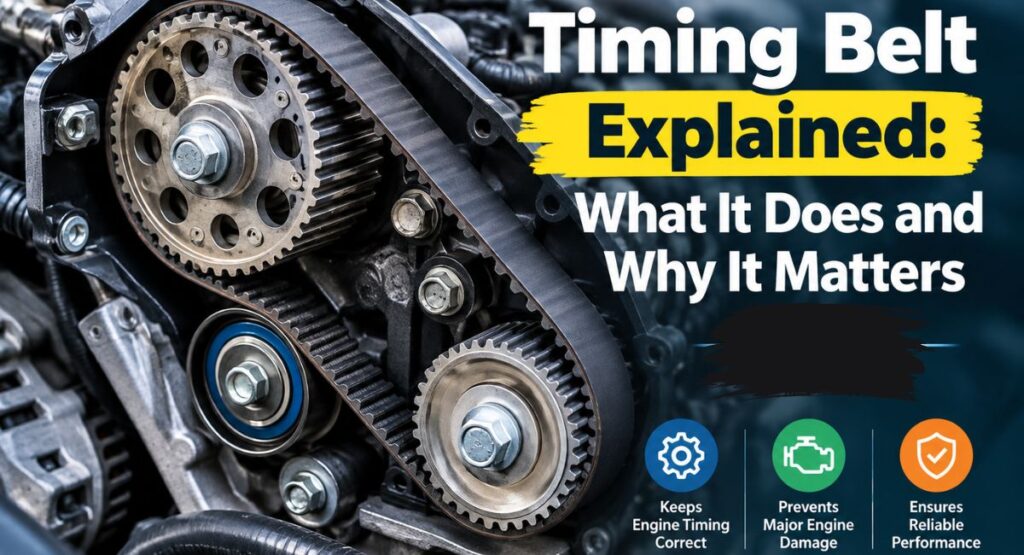
A timing belt — also called a cambelt, a car cam belt, or simply an engine timing belt — is a reinforced rubber loop, lined with teeth on its inner surface, that connects your engine’s crankshaft to its camshaft (or camshafts, on many modern engines). Its entire job is to keep these two components rotating in perfect, unbreakable sync, which in turn controls exactly when each cylinder’s valves open and close.
It looks unremarkable — just a black rubber band with teeth, wrapped around a few pulleys under a plastic cover — but its job is one of the most mechanically important in the entire engine. Without it working correctly, nothing else under the hood matters.
How a Timing Belt Actually Works
To understand why the timing belt matters, it helps to walk through what’s actually happening inside your engine every time you drive.
Step 1: The crankshaft spins. As fuel burns in the engine’s cylinders, it pushes the pistons down, and that motion rotates the crankshaft — the component that ultimately sends power to your wheels.
Step 2: The timing belt transfers that rotation to the camshaft. The belt’s teeth mesh precisely with cogs on both the crankshaft and camshaft, so as the crankshaft turns, it pulls the belt, which in turn spins the camshaft. According to AutoZone’s explanation of timing belt function, this connection is what coordinates the entire combustion cycle.
Step 3: The camshaft opens and closes the valves at exactly the right moment. Lobes on the camshaft physically push each intake and exhaust valve open at a precise point in the engine’s cycle, then let it close again. This has to happen in perfect rhythm with the pistons moving up and down beneath them.
Step 4: The cycle repeats, thousands of times per minute. Every single time your engine fires a cylinder, this entire sequence — crankshaft turns, belt transfers motion, camshaft opens and closes valves — has to happen with near-perfect precision. At highway RPM, this is happening dozens of times per second, for every cylinder in your engine.
That’s the “timing” in timing belt: it’s not a metaphor, it’s a literal, mechanical clock keeping every moving part of your engine’s internal choreography in sync.
The Components That Work Alongside the Timing Belt
The belt itself rarely works alone. A few supporting components share the job:
- Tensioner pulley: Keeps the belt under the correct tension. Too loose, and the belt can skip a tooth; too tight, and it wears out prematurely.
- Idler pulleys: Guide the belt around its path, helping it maintain the correct route between the crankshaft and camshaft(s).
- Water pump: On many vehicles, the timing belt also drives the water pump, which is exactly why the two are so often replaced together — they’re already mechanically connected and equally accessible during the same job.
Because these parts wear at a similar rate and share the same labor-intensive access point, a proper timing belt job typically means replacing the whole system together, not just the belt in isolation.
Timing Belt vs. Timing Chain vs. Timing Gears: Which Is Better?
Not every engine uses a rubber belt for this job, and understanding the alternatives helps explain why manufacturers make the choices they do.
- Timing gears: The oldest approach, found in older engines with the camshaft positioned close to the crankshaft. Simple, durable, but only practical when the two components sit near each other.
- Timing chains: A metal chain, similar in concept to a bicycle chain, connecting the same two components. According to Wikipedia’s overview of timing belt history, timing chains have become increasingly common since the 1990s, largely because they don’t require the scheduled replacement intervals that rubber belts do.
- Timing belts: Quieter than chains and cheaper to manufacture, timing belts became especially common on mass-production cars through the 1970s and 80s. Their tradeoff is durability — rubber degrades with heat and age in a way metal doesn’t, which is exactly why belts need periodic replacement and chains generally don’t.
Neither system is universally “better” — it’s a genuine engineering tradeoff between quieter, cheaper operation (belt) and lower long-term maintenance (chain), and manufacturers make this call differently across their own lineups, sometimes even within the same model depending on engine choice. A timing belt Toyota buyer might encounter belongs to a brand that uses both systems across its lineup — some Toyota engines use a belt, others a chain — while a timing belt Ford owner will find the same split: some Ford engines use a chain for lifetime durability, others use a belt with a scheduled interval. There’s no single answer for an entire brand; it comes down to the specific engine.
Timing Belt vs. Serpentine Belt: What’s the Difference?
These two are easy to confuse, since both are rubber belts living under the hood, but they do entirely different jobs. The timing belt is internal to the engine’s timing cover, synchronizes the crankshaft and camshaft, and directly affects whether your engine can run at all. The serpentine belt (sometimes called the drive belt or accessory belt) is visible on the outside of the engine and powers external components like the alternator, power steering pump, and air conditioning compressor.
The practical difference matters most when something fails: a broken serpentine belt typically causes a loss of power steering, battery charging, or air conditioning, but the engine itself generally keeps running. A broken timing belt, on many engines, stops the car immediately and can cause serious internal damage. Both deserve regular inspection, but the stakes — and the replacement cost — are usually quite different between the two.
What Is “Timing Belt” Called in Other Languages?
If you’re researching this component outside the US, terminology shifts. In the UK and much of the Commonwealth, it’s almost always called a cambelt. In Spanish, the standard automotive term is “correa de distribución” (literally, “distribution belt”), used consistently across repair manuals and parts catalogs in both Spain and Latin America. Knowing this is genuinely useful if you’re searching for parts, repair guides, or forums in a different language or region — the component and its function are identical, only the name changes.
What Is a Timing Belt Made Of?
Modern timing belts are typically constructed from EPDM rubber (ethylene propylene diene monomer), a synthetic rubber compound chosen specifically for its resistance to heat, oil exposure, and the constant flexing the belt undergoes every time the engine runs. Reinforcing cords — often made of fiberglass or a similar high-strength material — run through the belt’s body to give it the tensile strength needed to transfer rotational force without stretching. The teeth themselves are precision-molded to mesh exactly with the cogs on the crankshaft and camshaft pulleys, since even a small manufacturing inconsistency could throw off the exact synchronization the entire system depends on.
This construction is genuinely impressive when you consider what it’s being asked to do: flex around multiple pulleys, resist engine heat and oil contamination, and maintain exact tooth alignment through tens of millions of rotations over its service life — all while being, fundamentally, a piece of reinforced rubber. It’s also exactly why age and heat cycling matter so much for belt longevity, regardless of mileage; the rubber compound itself has a finite lifespan, independent of how gently or aggressively the car is driven.
Why the “Interference vs. Non-Interference” Design Matters
Here’s the detail that turns a routine maintenance item into a genuinely high-stakes one. On many modern engines, called interference engines, the pistons and valves actually occupy the same physical space in the cylinder — just at different moments in the engine’s cycle. As long as the timing belt keeps everything synchronized, this is completely safe. The piston is always out of the way by the time a valve swings into that space.
But if the belt slips or breaks, that choreography collapses instantly. A valve can be open at the exact moment a piston rises into its space, and the two collide — bending valves, damaging pistons, and sometimes cracking the cylinder head. This is precisely why a car with a broken timing belt on an interference engine can go from “needs a $900 scheduled service” to “needs a $3,000-$7,000 engine repair” in a single moment.
Non-interference engines, by contrast, have enough built-in clearance that a broken belt simply stops the engine without physical collision — inconvenient, but not catastrophic to the internals.
Step-by-Step: How to Understand Your Own Engine’s Timing System
Step 1: Search your exact make, model, year, and engine size. Timing systems vary not just between manufacturers but often between different engine options within the same model year.
Step 2: Determine whether you have a belt or a chain. This single fact determines whether you have a scheduled replacement interval to plan around at all.
Step 3: If you have a belt, find your interference status. This tells you how urgently to treat any warning signs — see our companion guide for the full list of symptoms to watch for.
Step 4: Check your owner’s manual for the exact mileage interval. Typically 60,000 to 100,000 miles for belt-equipped engines, but always verify against your specific vehicle’s documentation.
Step 5: Note it somewhere you’ll actually see it again. A calendar reminder, a note in your glovebox, or a simple maintenance log — anything that ensures this specific, high-stakes interval doesn’t quietly slip past you.
Why the Timing Belt Still Matters in 2026
With so much attention on hybrids and EVs, it’s worth addressing directly: does this component still matter? The honest answer is: for most drivers, yes, but the landscape is shifting.
Pure electric vehicles have no timing belt or chain at all — with no combustion engine, there’s simply no crankshaft-to-camshaft relationship to synchronize. This is one of several reasons EVs generally require less scheduled maintenance than gasoline vehicles.
Most modern hybrids, however, still rely on an internal combustion engine working alongside the electric motor, and the large majority of current hybrid engines use a timing chain rather than a belt, specifically to reduce long-term maintenance needs. A small number of older or unusual hybrid designs — like the original first-generation Honda Insight — did use a timing belt, so it’s still worth confirming rather than assuming based on the word “hybrid” alone.
For the enormous number of gasoline-only vehicles still on the road and still being sold, the timing belt remains exactly as relevant in 2026 as it’s ever been. If your car has a combustion engine and a belt (rather than a chain) connecting its crankshaft and camshaft, this component still deserves the same scheduled attention it always has.
Why It’s Worth Trusting Quality Parts and Genuine Expertise
Understanding how the timing belt works makes it clear why cutting corners on this specific component is such poor value. This isn’t a simple bolt-on part — it requires precise tooth alignment during installation, and a mistake here can cause the very engine damage the belt exists to prevent. Choosing a quality belt kit and a mechanic with genuine, verifiable experience on your specific engine isn’t just a nice-to-have — it’s the difference between a job that protects your engine for the next 60,000-100,000 miles and one that quietly undermines the very system it was meant to fix. Ask your mechanic to explain what they’re replacing and why; a shop that understands this system as well as we’ve just walked through it will always be able to answer confidently.
Timing Belt Warning Signs, Replacement, and Cost: Where to Go Next
Understanding what this component does is the foundation — but at some point, that understanding needs to turn into action. A few common timing belt warning signs worth knowing at a glance: a ticking or clicking noise from the front of the engine, rough idling, difficulty starting, a squealing sound near the timing cover, and visible cracking on the belt itself. For the full breakdown of every sign and exactly when timing belt replacement is due for your specific vehicle, see our companion guide, When to Change a Timing Belt? 7 Essential Signs & Replacement Tips. And once you know it’s time, our guide on Timing Belt Replacement Cost in 2026: What Should You Pay? will help you budget accurately and avoid overpaying.
Final Thoughts
The timing belt is a small, unglamorous part doing one of the most mechanically critical jobs in your entire engine — keeping thousands of split-second movements in perfect sync, every single time you drive. Understanding how it works doesn’t just satisfy curiosity; it explains exactly why manufacturers build in a replacement interval, and why ignoring that interval carries real risk.
If you’re ready to check where your own vehicle stands, our guide on When to Change a Timing Belt? 7 Essential Signs & Replacement Tips walks through the exact warning signs and intervals, and our Complete Guide to Car Maintenance: What to Check and When covers everything else your car needs on schedule. A little understanding of what’s happening under the hood goes a long way toward keeping it running the way it’s supposed to.
Frequently Asked Questions
What are signs of a bad timing belt?
Several warning signs tend to show up before a timing belt fails completely, and any one of them is worth acting on:
A ticking or clicking noise coming from the front of the engine, often the earliest and most common sign
Rough idling, hesitation, or engine misfires caused by valve timing slipping out of sync
Difficulty starting the engine, or longer-than-normal cranking before it catches
A high-pitched squealing or chirping sound near the timing cover, often pointing to a worn tensioner or idler pulley rather than the belt itself
Visible cracking, fraying, or a shiny, glazed appearance on the belt, if it’s accessible for inspection
Oil leaking near the front-center of the engine, which can accelerate belt wear over time
Any single one of these is a reason to have the belt inspected promptly, since these symptoms typically appear before complete failure, not after.
How much does it cost to replace a timing belt?
Across independent cost-estimating sources, the average lands around $880 to $1,300 for a complete job including parts and labor, though the realistic range runs from about $400 on the low end to $2,500 or more on the high end, depending heavily on your specific vehicle, engine layout, and whether the water pump is replaced at the same time. Labor typically makes up 60-70% of that total, since reaching the timing belt usually requires removing several other components first. Trucks, luxury vehicles, and engines with difficult access sit well above the average, while smaller 4-cylinder economy cars tend to sit below it.
Can I drive a car with a bad timing belt?
Technically yes, for a limited time, but it’s genuinely risky and not something worth pushing your luck on. Timing belts rarely fail instantly without warning — they usually give you some combination of the symptoms above first. However, once you notice ticking, squealing, rough idling, or visible wear, the belt could fail anywhere from a few days to a few months later, with no reliable way to predict exactly when. Because the actual failure can happen suddenly, the safest approach is to treat any of these symptoms as a reason to schedule service promptly, not something to put off — particularly if you’re unsure whether your engine is an interference design, where a snapped belt can cause serious internal engine damage rather than just stopping the car.
When should your timing belt be changed?
As a general rule, most manufacturers recommend changing the timing belt every 60,000 to 100,000 miles, or every 5 to 10 years, whichever comes first. The exact number varies by manufacturer and engine, so checking your owner’s manual for your specific vehicle’s interval is the most reliable way to know for certain. A few factors can shorten that window: severe driving conditions (extreme heat or cold, frequent short trips), a manual transmission, and simply the age of the belt regardless of mileage, since rubber degrades over time even on a lightly driven car.
What is the average lifespan of a timing belt?
Most timing belts are designed to last 60,000 to 100,000 miles, or roughly 5 to 10 years, whichever comes first. Older vehicles (generally pre-1998) often used a more conservative 60,000-mile standard, while many newer belts, built with improved rubber compounds, can safely reach 90,000 to 100,000 miles. It’s worth treating this figure as a maximum to plan around rather than a guarantee, since driving conditions and simple age can shorten the realistic lifespan compared to the manufacturer’s baseline number.
Do you get a warning before the timing belt goes?
Usually, yes — outright failure with zero warning is relatively uncommon. Most timing belts show at least one of the symptoms covered above (ticking, rough idling, squealing, visible cracking, or an oil leak nearby) in the days, weeks, or occasionally months before complete failure. That said, “usually” isn’t “always,” and once a belt is well past its recommended mileage or time interval, the risk of a sudden failure with little practical warning increases significantly. This is exactly why manufacturers set a scheduled replacement interval in the first place, rather than relying on drivers to catch a symptom in time — the safest strategy combines watching for warning signs and respecting the mileage-based interval, rather than depending on either one alone.