A neighbor of mine ignored a faint clicking sound every time she turned into her driveway for almost two months. “It only happens when I turn the wheel sharp,” she said, like that made it less worth worrying about. By the time she finally got it checked, her worn CV joint had deteriorated from a simple $200 boot repair into a full axle replacement closer to $700. Two months of clicking, and the fix went from “easy” to “ouch” without her ever hitting a pothole or doing anything unusual.
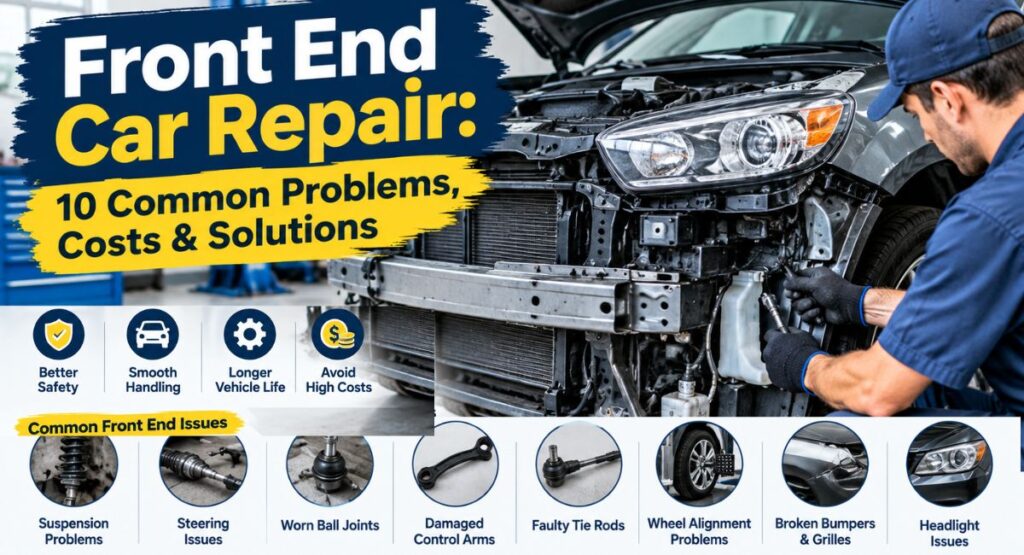
That’s the theme running through this entire guide. Front end car repair — sometimes called auto front end repair or automotive front end repair, and generally just referred to as front end work on a car — covers a cluster of components, struts, ball joints, tie rods, CV joints, wheel bearings, and more, that all tend to fail the same quiet way: a small noise or feeling that’s easy to dismiss until it isn’t. This article walks through ten of the most common front-end problems, what causes each one, what it costs to fix, and how to tell them apart, since several of these components produce symptoms that sound almost identical to an untrained ear.
Car Front End Parts Diagram: What’s Actually Under There
Before diagnosing any of the ten problems below, it helps to have a mental picture of what’s actually sitting behind your front bumper. Picture it roughly like this, working from the wheel inward:
- Strut or shock — the vertical component absorbing bumps, usually with a coil spring wrapped around it
- Control arm — connects the wheel assembly to the car’s frame, pivoting as the suspension moves
- Ball joint — sits at the outer end of the control arm, allowing the wheel to pivot for steering
- Tie rod end — connects the steering rack to the steering knuckle, translating wheel-turning into actual steering
- Sway bar link — connects the sway bar to the suspension on each side, controlling body lean
- CV axle and joint — runs from the transmission to the wheel hub, delivering power while flexing with steering and suspension movement
- Wheel bearing — sits inside the hub, letting the wheel spin freely
- Steering knuckle — the central hub that the ball joint, tie rod, and wheel bearing all attach to
A rough car front end parts diagram like this is worth keeping in mind as you read through the ten problems below, since several of these components sit only inches apart and can be genuinely tricky to tell apart by symptom alone.
1. Worn Struts or Shocks
The problem: Excessive bouncing after bumps, a nose-dive feeling under braking, or a car that leans heavily in corners.
What’s happening: Your struts (or shocks, depending on your suspension design) are responsible for absorbing bumps and controlling how your car’s body moves. As they wear out, they lose their ability to dampen that motion, letting the car bounce, sway, and settle unevenly.
How to tell: Push down firmly on one corner of the parked car and let go. If it bounces more than once or twice before settling, the strut or shock on that corner is likely worn.
The cost: Front struts typically run $450 to $900 per pair, including parts and labor, plus a wheel alignment afterward, which most reputable shops bundle in rather than treat as optional. A full four-corner job commonly lands between $900 and $1,800.
2. A Bad Ball Joint
The problem: A dull clunking noise over bumps, potholes, or driveways, often worse under braking or acceleration.
What’s happening: The ball joint connects your control arm to the steering knuckle, allowing the wheel to pivot smoothly. As it wears, play develops inside the joint, letting the wheel shift slightly out of its intended position every time weight shifts onto the front end.
How to tell: The clunk typically gets worse specifically when braking or accelerating over an uneven surface, since that’s when weight transfer settles a loose joint into contact with something it shouldn’t touch.
The cost: Ball joint replacement runs $200 to $900 per joint depending on your vehicle, with the price climbing significantly if the joint is pressed into the control arm rather than bolted in, or if it’s only sold as part of a full control arm assembly (common on many trucks and SUVs).
3. Failing Tie Rod Ends
The problem: Loose, vague steering response, a shaky steering wheel, or uneven tire wear on the edges.
What’s happening: Tie rod ends connect your steering rack to the steering knuckle, translating your steering wheel input into the wheels actually turning. Once worn, they introduce play into that connection, and your wheels no longer respond precisely to steering input.
How to tell: A tie rod problem tends to feel like the steering wheel is “talking back”, loose on-center, with a slight delay before the car actually responds to your input, rather than a clunk you feel through bumps.
The cost: Tie rod replacement typically runs $100 to $300 per side, making it one of the more affordable repairs on this list, assuming it hasn’t caused secondary alignment or tire wear damage from being ignored too long.
Step-by-Step: Telling Ball Joints, Tie Rods, and Control Arms Apart
Since these three components produce such similar symptoms, here’s a simple process to narrow things down before you call a mechanic:
- Note exactly when the noise or feeling happens. A clunk over bumps points toward a ball joint or control arm bushing. A loose, delayed steering feel points toward a tie rod.
- Check if it changes under braking versus steering. Ball joint play often worsens under braking load. Tie rod looseness shows up most when you make small steering corrections.
- Look for a “floating” sensation in corners. This points more toward a worn control arm bushing than either of the other two.
- If you’re unsure, don’t guess which part to buy. A shop can load-test each joint individually (pushing and pulling the wheel at specific clock positions) to confirm exactly which component is at fault, saving you from replacing the wrong part first.
4. Clicking CV Joints
The problem: A rhythmic clicking or popping sound when turning, especially during tight, low-speed turns like pulling out of a parking space.
What’s happening: Your CV joint (constant velocity joint) allows power to reach your wheels while still letting them turn and move with the suspension. Once the protective rubber boot cracks or tears, grease escapes, dirt gets in, and the joint starts to wear and click under load, almost always the outer joint on the side you’re turning toward.
How to tell: This is the exact mistake my neighbor made, dismissing a clicking sound that only happened on tight turns. According to GKN, the world’s largest OEM driveshaft supplier, by the time a CV joint is audibly clicking, it has typically already lost more than 80% of its protective grease.
The cost: Catch a torn boot early, before clicking starts, and a boot repair alone might run under $100. Once clicking has started, expect a full CV axle replacement, typically $150 to $550 per axle, parts and labor combined.
5. Wheel Bearing Noise
The problem: A constant humming, growling, or droning noise that gets louder as you drive faster, regardless of whether you’re turning.
What’s happening: Your wheel bearing sits inside the wheel hub and lets the wheel spin freely with minimal friction. As it wears, that friction increases, generating heat and noise that scales directly with speed.
How to tell: This is the component most commonly confused with a CV joint, so here’s the key distinction: CV joint noise clicks and is tied to turning; wheel bearing noise hums or growls steadily and is tied to speed, not steering input. If the noise doesn’t change much whether you’re going straight or turning, suspect the bearing.
The cost: Wheel bearing replacement typically runs $150 to $400 per wheel, making an accurate diagnosis genuinely valuable, since replacing a CV axle when the bearing was the actual problem (or vice versa) wastes real money.
6. Worn Sway Bar Links
The problem: A clunking or rattling noise over bumps or speed bumps, often more noticeable on one side, along with increased body roll in corners.
What’s happening: Sway bar links connect your sway bar to the suspension, helping control how much your car leans during turns. The small ball joints inside each link wear out over time, especially on rough roads, introducing play that creates noise and reduces handling stability.
How to tell: This is genuinely one of the more affordable sources of front-end clunking, so it’s worth ruling out before assuming something more expensive is wrong.
The cost: Sway bar link replacement is one of the cheapest items on this list, typically $100 to $300 per link, including parts and labor.
7. Power Steering Problems
The problem: Heavier-than-normal steering effort, a whining noise when turning, or a steering wheel that feels notchy or inconsistent.
What’s happening: Whether your car uses a hydraulic power steering pump or an electric power steering system, a failure here directly affects how much effort it takes to turn the wheel. Hydraulic systems can develop fluid leaks or a failing pump; electric systems can develop sensor or motor faults.
How to tell: A whining noise that changes pitch with engine RPM, specifically when turning, points toward a hydraulic pump or low fluid level. A steering wheel that feels inconsistent or occasionally loses assist entirely points more toward an electric system fault.
The cost: This varies enormously depending on whether it’s a simple fluid top-off and leak repair (under $100) or a full pump or rack replacement (which can run well into four figures), making an accurate diagnosis especially important here.
8. Alignment Issues
The problem: The car pulling to one side on a flat, straight road, uneven tire wear, or a steering wheel that isn’t centered when driving straight.
What’s happening: Your wheels are set to precise angles, called alignment, that keep your car tracking straight and your tires wearing evenly. Hitting a pothole hard, a curb strike, or simply the wear and settling of suspension components over time can throw this off.
How to tell: Alignment problems are often a symptom of something else on this list wearing out, so if you fix a tie rod or ball joint and don’t also get an alignment, don’t be surprised if the pulling or uneven wear continues.
The cost: A wheel alignment typically runs $75 to $200, and is worth bundling with nearly every other repair on this list, since most front-end work changes your suspension geometry slightly.
9. Worn Control Arm Bushings
The problem: A vague, “floating” feeling in corners, or the whole wheel’s position seeming to shift slightly when you go from braking to accelerating.
What’s happening: Control arm bushings are rubber or polyurethane cushions that let the control arm move while still keeping it securely located. As they wear or crack, the control arm gains play, letting the wheel’s position shift slightly under changing forces.
How to tell: Unlike a ball joint’s sharper clunk, worn bushings tend to produce a softer, less defined looseness, more of a general feeling that the front end isn’t quite as planted as it should be.
The cost: Bushing replacement alone is relatively affordable, often under $150 per side, though if they’re only available as part of a full control arm assembly, costs climb toward $200 to $500 per side.
10. General Front-End Noise You Can’t Quite Place
The problem: Some combination of clunking, popping, or looseness that doesn’t clearly match any single symptom above.
What’s happening: This is genuinely common, since several of these components sit close together and can develop problems around the same time, especially on an older vehicle. A worn ball joint can accelerate tie rod wear; a bad strut mount can mimic bearing noise; a torn sway bar link boot can sound a lot like a CV joint.
The fix: This is exactly the situation where a proper diagnostic inspection earns its cost. A shop that physically loads and unloads each joint, rather than just listening and guessing, can isolate the actual source far more reliably than any noise-based checklist, including this one.
Front End Car Repair Cost: All 10 Problems at a Glance
Pulling every number from this guide into one place, here’s a realistic sense of front end car repair cost across the components covered above:
| Problem | Typical Cost |
|---|---|
| Struts/shocks (front pair + alignment) | $450 – $900 |
| Ball joint (per joint) | $200 – $900 |
| Tie rod end (per side) | $100 – $300 |
| CV axle (per axle) | $150 – $550 |
| Wheel bearing (per wheel) | $150 – $400 |
| Sway bar link (per link) | $100 – $300 |
| Power steering (varies widely) | $100 – $1,000+ |
| Wheel alignment | $75 – $200 |
| Control arm bushings (per side) | $150 – $500 |
As the table makes clear, several of these repairs overlap in labor, replacing a ball joint or tie rod almost always calls for an alignment afterward, which is exactly why bundling related work in a single visit is usually smarter than tackling one symptom at a time.
Front End Diagnostic Cost: What You’ll Pay to Find Out What’s Wrong
Before any repair, most shops start with a diagnostic inspection to pinpoint which of these ten components is actually at fault. Front end diagnostic cost varies by shop: many tire and brake chains offer a basic front-end check for free as a way to get you in the door, while independent shops and dealerships sometimes charge a diagnostic fee, often in the $50 to $150 range, which is frequently waived or credited toward the repair if you move forward with the work. It’s always worth asking upfront whether the inspection is free or billed, and whether that fee applies toward your final bill.
What Is a Front End Check at Mavis?
Since this comes up often, it’s worth answering directly: Mavis offers a free front end check as one of several complimentary courtesy inspections, alongside their brake check, suspension check, battery check, and exhaust check. A technician visually inspects your front-end components, ball joints, tie rods, struts, and related hardware, while the car is lifted, looking for play, wear, or damage, then lets you know what they find. It’s a genuinely useful, no-cost starting point if you’re hearing a noise but aren’t sure where to begin, though keep in mind that a visual check alone won’t always catch everything an alignment machine or a more thorough diagnostic would, so treat it as a helpful first opinion rather than the final word.
Why It’s Worth Choosing Quality Parts and an Experienced Shop
Front-end components work together as a system, and cutting corners on one tends to accelerate wear on the others. A cheap, poorly made ball joint or bushing can fail early and throw off your alignment, which then wears your tires unevenly, which then strains your tie rods, and so on. Choosing quality, reputable parts and a shop experienced specifically with front-end and suspension diagnosis, not just general repairs, gives you real confidence that the part actually being replaced is the part that’s actually wrong. Ask your mechanic to show you the worn component and explain how they isolated it, a shop that can clearly demonstrate their diagnosis is one worth trusting with a system this interconnected.
Final Thoughts
Front-end problems rarely arrive as a single, obvious symptom. They show up as a faint click, a slight clunk, a bit of extra body roll, exactly the kind of thing that’s easy to dismiss the way my neighbor dismissed her CV joint. Learning to tell these ten issues apart, even roughly, means you’ll catch them while they’re still the cheaper version of the repair rather than the expensive one.
For everything else your car needs on a regular schedule, see our Complete Guide to Car Maintenance: What to Check and When, and if it’s specifically your brakes acting up, our guide to Brake System Maintenance: 10 Essential Tips for Safer Braking covers that system in full. A little attention to the noises your front end makes today can save you from a much bigger bill tomorrow.
Frequently Asked Questions:
How much does it cost to fix a front-end on a car?
It depends heavily on which specific component is actually failing, since “front-end repair” covers a wide range of parts. On the affordable end, a sway bar link runs $100 to $300, and a tie rod end runs $100 to $300 per side. In the middle, wheel bearings run $150 to $400 per wheel and a CV axle runs $150 to $550. On the higher end, ball joints can run $200 to $900 per joint, and a full pair of struts with an alignment typically lands between $450 and $900. If several components need attention at once, which isn’t unusual since they wear together, total front-end repair bills commonly land somewhere between $400 and $1,500, depending on exactly what’s involved.
What is front-end repair?
Front-end repair refers to fixing the components that make up your car’s front suspension and steering system, the parts responsible for absorbing bumps, keeping your wheels pointed the right direction, and letting your wheels turn and move independently of each other. This includes struts or shocks, ball joints, tie rod ends, control arm bushings, sway bar links, CV joints and axles, wheel bearings, and the power steering system, plus the wheel alignment that often needs adjusting after any of these parts are replaced. It’s worth noting that “front-end repair” can also refer to something entirely different, fixing collision or crash damage to the front of a vehicle’s body. Mechanically, these are two separate categories: one is wear-and-tear suspension and steering work, the other is bodywork. This guide focuses on the former.
Can a car with front-end damage be repaired?
This depends on which meaning of “front-end damage” applies. If you mean worn or failed suspension and steering components, like the ten problems covered in this guide, yes, these are routine, well-understood repairs that shops handle every day, and in the vast majority of cases they’re entirely fixable at a cost proportional to what’s actually worn. If you mean collision damage from an accident, the answer is usually also yes, but it depends on severity. Minor to moderate collision damage (a bent bumper, a damaged radiator support, misaligned body panels) is commonly repairable. More severe damage that affects the car’s structural frame can sometimes still be repaired but may not be financially worthwhile if repair costs approach or exceed the vehicle’s value, in which case an insurer may declare it a total loss instead. A qualified body shop or insurance adjuster can assess which category a specific collision falls into.
What is the most difficult repair on a car?
Among routine repairs, a few consistently rank among the most difficult and labor-intensive: a timing belt replacement (especially on interference engines, where precision timing marks and specialty tools are required), an engine or transmission rebuild, a head gasket replacement (which requires significant engine disassembly), and certain pressed-in wheel bearing or ball joint jobs that require a hydraulic press rather than simple hand tools. What makes these difficult isn’t usually conceptual complexity, it’s the combination of precision requirements, specialty tools, and the sheer number of other components that have to come off first just to reach the actual problem. This is exactly why these particular jobs are the ones most worth leaving to an experienced professional rather than attempting as a first-time DIY project.
Which part of a car is most expensive to fix?
The engine and transmission are consistently the two most expensive systems to repair or replace, since both are complex, labor-intensive, and central to the car’s operation. A full engine replacement commonly runs anywhere from $4,000 to $10,000 or more depending on the vehicle, while a transmission replacement often falls in a similar range. Beyond those two, a few other notably expensive repairs include a full hybrid or EV battery pack replacement (which can run into five figures on some vehicles), a turbocharger replacement, and in rare cases, significant structural frame damage from a serious collision. By comparison, most of the front-end components covered in this guide, while they can add up, are genuinely modest next to these big-ticket systems.
What is the 30-60-90 rule for cars?
The 30-60-90 rule is an informal maintenance framework recommending major service checkpoints at 30,000, 60,000, and 90,000 miles. At 30,000 miles, typical tasks include an air filter replacement, a more thorough fluid check, and tire rotation. At 60,000 miles, it often expands to spark plugs, a full brake inspection, and a first look at suspension components like struts, shocks, and ball joints. At 90,000 miles, bigger jobs tend to show up, including timing belt replacement (on belt-equipped engines), transmission fluid service, and a more comprehensive suspension and steering evaluation. It’s worth treating this as a helpful general framework rather than a strict rulebook, since your specific owner’s manual, built around your exact engine and components, is always the more accurate source for your vehicle’s actual intervals.