Ask ten drivers to define vehicle maintenance, and you’ll probably get ten different answers. Some picture an oil change. Others picture a mechanic waving a clipboard. A friend of mine once told me he thought maintenance was just “whatever the dealership tries to sell you at checkout.” None of these are wrong, exactly — but none of them capture the full picture either.
This article breaks down the concept itself: what vehicle maintenance actually means, the different types it comes in, why it matters, and how to build it into a habit you can actually stick to. If you’re looking for a full car maintenance schedule by mileage — exactly what to check and when — our Complete Guide to Car Maintenance: What to Check and When covers that in detail. This article focuses on the concept behind it — what it really means to maintain a vehicle, and why it’s worth taking seriously.
Define Vehicle Maintenance: The Core Concept
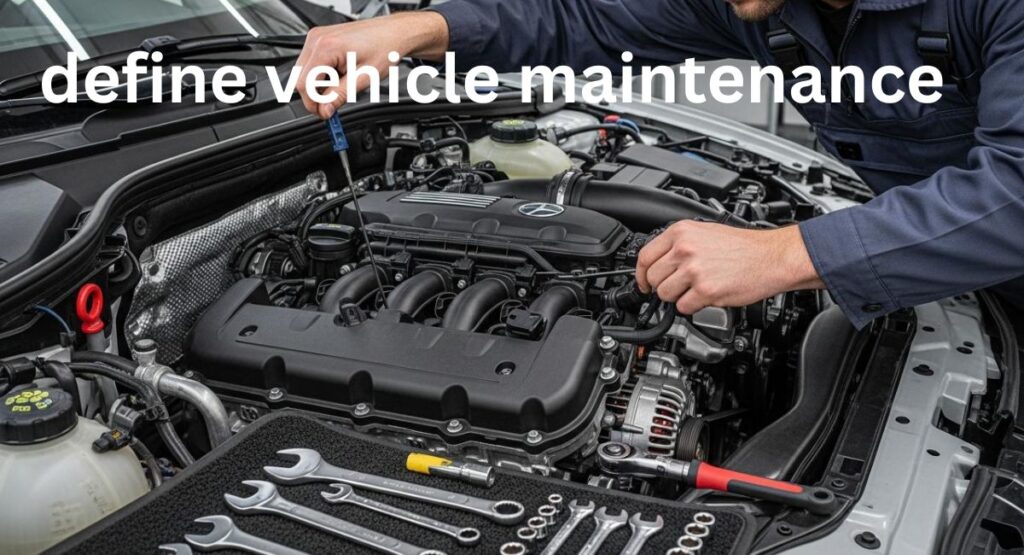
Vehicle maintenance is the ongoing process of inspecting, servicing, and repairing a vehicle’s systems and components to keep it operating safely, reliably, and efficiently over its lifespan. In simpler terms, it’s everything you do — or have done — to a car so it keeps working the way it’s supposed to, rather than waiting for something to break.
This is the car maintenance definition in its broadest sense: a combination of scheduled tasks (like oil changes and tire rotations), condition-based checks (like inspecting brake pads when they seem worn), and occasional repairs that come up along the way. It covers the engine, transmission, brakes, tires, electrical system, fluids, and just about every other component that helps a vehicle run.
What makes this definition worth sitting with is what it excludes. Vehicle maintenance isn’t the same as customizing a car, washing it, or upgrading its stereo system. It’s specifically about function and safety — keeping the machine doing what it was built to do, for as long as possible.
What Is Auto Maintenance, Exactly?
If you’re wondering what is auto maintenance compared to “vehicle maintenance,” the honest answer is: they mean the same thing. “Auto maintenance” and “vehicle maintenance” are used interchangeably across the industry, with “auto” simply being shorthand for automobile.
Here’s a simple auto maintenance services definition you’ll see used by repair shops and dealerships: it’s the specific menu of preventive tasks they offer under one umbrella — oil changes, tire rotations, brake inspections, fluid flushes, filter replacements, and similar services, usually bundled into a single visit.
That said, there’s a subtle nuance worth mentioning. “Auto maintenance” tends to get used more often in a commercial context — think of a shop’s website listing “auto maintenance services” as a category of what they sell — while “vehicle maintenance” shows up more often in owner’s manuals, fleet management, and technical documentation. Functionally, though, you can treat the two as synonyms.
Define Car Service vs. Vehicle Maintenance
People often use “maintenance” and “service” as if they’re the same thing, but there’s a subtle distinction worth understanding, and it trips up a lot of first-time car owners.
- Vehicle maintenance is the broad, ongoing practice — the overall discipline of keeping a car in good condition over time.
- A car service (or “getting your car serviced”) is a specific visit or appointment where a set of maintenance tasks is actually performed, usually based on your car’s mileage or the time since your last visit.
Put simply: maintenance is the what and why, while a service appointment is the when and how — one visit where several maintenance tasks get checked off at once. Think of it the way you’d think of “fitness” versus “a gym session.” Fitness is the ongoing goal; a gym session is one specific event that contributes to it. If you want a deeper breakdown of what actually happens during one of these appointments, our article on what it means to get your car serviced covers that in detail.
The Main Types of Vehicle Maintenance
Not all maintenance works the same way, and understanding the differences actually changes how you approach your own car. Mechanics, fleet managers, and even aircraft technicians generally group maintenance into a few recognized categories.
1. Preventive Maintenance
This is maintenance performed on a fixed schedule — by mileage, time, or both — regardless of whether anything seems wrong yet. Think oil changes every few thousand miles or a coolant flush every couple of years. According to SAP’s overview of preventive maintenance, this proactive approach is designed to catch small issues before they cause a bigger failure, and it typically results in reduced downtime, a longer component lifespan, and more predictable costs.
Anecdote: My uncle has driven the same pickup truck for over 280,000 miles. His secret isn’t luck — it’s a laminated index card taped inside his glovebox listing every service interval for his exact model. He follows it religiously, and his mechanic jokes that the truck runs better than cars half its age. That’s regular maintenance in action.
2. Predictive Maintenance
Rather than following a fixed calendar, predictive maintenance relies on monitoring the actual condition of a component and acting when data suggests it’s needed. In consumer vehicles, this shows up as things like oil-life monitoring systems, tire-pressure sensors, or brake-wear indicators that alert you based on real conditions rather than a strict mileage number. As one industry comparison of preventive and predictive maintenance explains, predictive maintenance is triggered by real-time data rather than a predetermined interval, which helps avoid both premature part replacement and unexpected failure.
3. Corrective (Reactive) Maintenance
This is maintenance performed after something has already gone wrong — replacing a part once it fails or fixing a system once it stops working correctly. It’s sometimes called “reactive maintenance” or “breakdown maintenance,” since the car dictates the timing, not a schedule. Industry sources note that corrective maintenance is essentially the opposite of preventive maintenance, since it addresses problems only after they’ve already occurred — which is why it tends to be less predictable and, in many cases, more expensive than catching the same issue early.
4. Scheduled/Routine Maintenance
This overlaps with preventive maintenance but specifically refers to the manufacturer’s official service intervals — the schedule printed in your owner’s manual. This is what most people mean by “regular maintenance car” upkeep: it’s the baseline every car owner should follow, regardless of how the vehicle “feels” day to day, since some components wear out silently, without any obvious symptoms.
In practice, most car owners rely on a mix of all four: following the scheduled plan, reacting to dashboard warnings (a form of predictive maintenance), and occasionally dealing with the unexpected repair.
Car Maintenance: How Often Should You Really Do It?
One of the most common questions people have once they understand what maintenance is, is how often it actually needs to happen. The honest answer is: it depends on the task, your mileage, and your driving conditions — but a rough cadence looks like this:
- Monthly: quick visual checks — tire pressure, fluid levels, lights.
- Every 3–6 months: tire rotation, wiper blades, battery terminal checks.
- Annually (or by mileage milestones): brake inspections, filter replacements, coolant checks, and a full multi-point inspection.
This cadence holds true across most vehicles, though it shifts based on age, climate, and how you drive — a car used mostly for short city trips or towing typically needs more frequent attention than one used for long highway commutes. For the exact mileage-by-mileage breakdown of every system, our car maintenance schedule by mileage in the pillar guide walks through each interval in detail.
Car Maintenance Checklist: How to Start a Vehicle Maintenance Routine
If all of this feels overwhelming, here’s the good news: building a maintenance habit doesn’t require any mechanical expertise. It just requires a system. Here’s a simple, practical car maintenance checklist approach to get started.
Step 1: Find your manufacturer’s maintenance schedule. Check your owner’s manual, or search your vehicle’s make, model, and year online. This document lists exactly which tasks are due at which mileage intervals — it’s the single most important reference you’ll use.
Step 2: Log your current mileage and service history. If you don’t already know when your last oil change, tire rotation, or brake inspection happened, start there. A quick call to your last mechanic, or a look through old receipts, usually fills in the gaps.
Step 3: Set reminders based on mileage or time. Whether it’s a calendar app, a spreadsheet, or a note in your phone, set a reminder for your next few service intervals. Many newer vehicles also have built-in maintenance reminder systems that do this automatically.
Step 4: Choose a trusted mechanic or service center. Consistency matters here. A shop that’s serviced your car before will have your history on file and can spot patterns or recurring issues more easily than a new shop starting from scratch.
Step 5: Keep records of every service. Save receipts, digitally or physically. This protects your warranty, supports resale value, and gives you (or any future mechanic) a clear picture of your car’s maintenance history.
Step 6: Reassess as your car ages. Maintenance needs change over time — older vehicles often need more frequent attention to certain systems, like belts, hoses, and suspension components. Revisit your schedule every year or two to make sure it still fits your car’s actual condition.
Vehicle Maintenance PDF: Free Checklist Resources You Can Download
If you’d rather work from a printed reference than remember everything, a vehicle maintenance PDF is one of the easiest tools to keep in your glovebox. Two genuinely useful, free options:
- The Car Care Council’s printable service schedule organizes maintenance by vehicle system, so you can check items off as they’re completed.
- The FTC’s Auto Repair Basics guide (PDF) isn’t a checklist in the traditional sense, but it’s a genuinely useful car maintenance checklist PDF-style reference that also explains your rights around warranties and repair shops.
Prefer something digital? Create a simple spreadsheet with columns for “Item,” “Last Checked,” “Mileage,” and “Next Due,” and list each maintenance category — oil, tires, brakes, battery, coolant, transmission, filters, belts — as its own row.
What Is Car Maintenance Cost?
A fair question once you understand what maintenance involves is simply: what is car maintenance cost, in real numbers? According to AAA-based cost data compiled by Insurify, routine car maintenance averages around $792 per year, or about $66 a month — a modest, predictable cost compared to the unpredictable expense of a major repair. That figure covers the basics: oil changes, tire rotations, fluid top-offs, and routine inspections, and it typically climbs somewhat as a vehicle ages and needs more frequent attention.
It’s worth stepping back and asking why any of this is worth the time and money beyond the dollar figure. A few core reasons stand out:
- Improved safety — components like brakes, tires, and steering directly affect your ability to control the vehicle; neglecting them raises real safety risks for you, your passengers, and everyone else on the road.
- Reliability — regular maintenance dramatically lowers the odds of an unexpected breakdown at an inconvenient (or dangerous) time, like a highway shoulder at night.
- Cost control — small, scheduled maintenance tasks are almost always cheaper than the large repairs that result from ignoring early warning signs.
- Longevity — a well-maintained vehicle simply lasts longer, often by tens of thousands of miles compared to a neglected one.
- Value retention — a documented maintenance history is one of the first things a buyer or appraiser checks when it’s time to sell.
What Happens If You Skip Vehicle Maintenance?
It’s tempting to think of maintenance as optional, especially when the car still seems to run fine. But problems that get ignored rarely stay small. The FTC’s own guidance on auto repair warns that neglecting even simple routine maintenance, like changing the oil or checking the coolant, can lead to poor fuel economy, unreliability, or costly breakdowns — and in some cases, it may even affect your warranty coverage.
Anecdote: A coworker of mine once put off a coolant flush for over two years because “the car wasn’t overheating.” Eventually, a slow leak she never noticed caused the engine to run hot on a summer drive, and by the time the temperature gauge caught her attention, the damage was already done — a repair bill that cost more than three years of routine maintenance combined. Her mechanic put it simply: “The car was trying to tell you something the whole time. You just weren’t checking.”
Skipping maintenance doesn’t usually cause an immediate, dramatic failure. More often, it’s a slow accumulation of small issues — a worn belt here, a low fluid level there — that eventually compound into something expensive, or dangerous. That’s the core argument for maintenance as a discipline rather than a reaction: the cost of neglect is rarely paid all at once, but it is almost always paid eventually.
Vehicle Maintenance vs. Car Repair: What’s the Difference?
One last distinction worth clearing up: maintenance and repair aren’t the same thing, even though they’re closely related.
- Maintenance is proactive — it’s meant to prevent problems.
- Repair is reactive — it’s meant to fix a problem that already exists.
A tire rotation is maintenance. A tire replacement after a blowout is a repair. An oil change is maintenance. Replacing a seized engine is a repair. The line blurs sometimes (replacing worn brake pads before they fail could be called either), but generally speaking, if you’re doing it before something breaks, it’s maintenance; if you’re doing it after, it’s a repair.
DIY vs. Professional Vehicle Maintenance
Another common question is how much of this you actually need a professional for. The honest answer: it depends on your comfort level and your car.
Tasks many owners handle themselves:
- Checking and topping off fluids
- Checking tire pressure and tread
- Replacing wiper blades
- Replacing an engine air filter (on many vehicles, this is a simple, tool-free job)
Tasks best left to a professional:
- Brake system service
- Timing belt or timing chain work
- Transmission service
- Anything involving the vehicle’s electrical or computer systems
There’s no shame in handling the simple stuff yourself while leaving the more technical work to a trained technician — in fact, that combination is exactly how most experienced car owners approach maintenance.
Common Myths About Vehicle Maintenance
A few misconceptions tend to circulate, and they’re worth addressing directly.
Myth: “A car that’s running fine doesn’t need any maintenance.” Quite a few maintenance problems, such as a low coolant level or thinning brake pads, give off no obvious warning signs until the damage has already been done. A smoothly running engine today doesn’t guarantee one tomorrow.
Myth: “You never have to change synthetic oil.” Synthetic oil outlasts the conventional kind, but it still wears down as mileage and time pile up. It pushes the change interval further out — it doesn’t do away with it.
Myth: “Dealership maintenance is always required to keep your warranty valid.” According to the FTC’s guidance on auto warranties, you’re free to have maintenance performed at any qualified shop, as long as the work meets the manufacturer’s specifications and you keep documentation — the dealership isn’t the only valid option, and denying warranty coverage on that basis alone is illegal.
Why It Pays to Choose Trusted Maintenance Providers and Parts
Once you understand what vehicle maintenance actually involves, the next logical step is choosing who — and what — you trust to carry it out. Not all parts, fluids, or shops are created equal, and this is where a little research pays off significantly.
Cheap, off-brand components might save a few dollars upfront, but they tend to wear out faster, fit less precisely, and can put unnecessary strain on the rest of the vehicle. Choosing manufacturer-recommended parts, quality fluids, and a certified, well-reviewed technician is one of the smartest investments you can make in your car’s long-term reliability. Ask about certifications, read reviews, and don’t hesitate to ask your mechanic why they’re recommending a specific part or fluid — a good shop will always be able to explain their reasoning. Vehicles maintained with trusted, quality components consistently show fewer breakdowns, lower long-term costs, and stronger resale value, which makes that upfront confidence well worth it.
Final Thoughts
At its core, to define vehicle maintenance is simply to describe the discipline of staying ahead of problems instead of reacting to them. Whether you call it auto maintenance, car care, or just “regular maintenance,” it all comes down to the same idea: spot small problems while they’re still small, stick to a consistent schedule, and treat caring for your vehicle as a lasting habit rather than a box you check once.
Once you understand the concept, the next natural step is knowing exactly what to check and when — which is exactly what our Complete Guide to Car Maintenance: What to Check and When walks you through, system by system. Between understanding what maintenance means and knowing what to actually do, you’ll be well ahead of most drivers on the road — and your car, quite literally, will thank you for it.
Frequently Asked Questions
What is a short definition of maintenance?
In its simplest form, maintenance is the work done to keep something functioning properly, safely, and efficiently over time — whether that “something” is a car, a machine, or a piece of equipment. In the context of vehicles specifically, maintenance means the routine inspections, servicing, and small repairs performed to prevent breakdowns and keep a car running the way it was designed to. It’s proactive by nature: the goal is to catch and fix small issues before they turn into bigger, more expensive problems, rather than simply waiting for something to fail.
What is the main maintenance of a vehicle?
If you had to name the single most important maintenance task for any vehicle, it would be regular engine oil changes. Oil lubricates the engine’s moving parts, reduces friction, and carries away heat — without it, an engine can suffer serious, often irreversible damage within a very short time. That said, “main” maintenance really depends on what keeps a car both running and safe, so most mechanics would point to a short list of core tasks that matter most:
Engine oil and filter changes — protects the engine itself
Tire care — pressure, tread, and rotation, since tires are your only contact with the road
Brake system checks — pads, rotors, and fluid, which directly affect your ability to stop safely
Battery and charging system checks — prevents the most common roadside breakdown
Fluid levels — coolant, transmission, and power steering fluid, which protect major systems from overheating or excess wear
Among these, oil changes are usually considered the single most foundational habit, since neglecting them can cause catastrophic engine failure faster than almost any other maintenance lapse.
What are the 7 types of maintenance?
While our main article covers the four categories most relevant to everyday car owners (preventive, predictive, corrective, and scheduled), the broader maintenance field — used across industries like manufacturing, aviation, and facilities management — commonly recognizes seven types:
Preventive maintenance — scheduled work performed at fixed intervals to prevent failures before they happen.
Predictive maintenance — maintenance triggered by real-time monitoring or sensor data, rather than a fixed schedule.
Corrective maintenance — repairs made after a problem has already occurred.
Reactive maintenance — closely related to corrective maintenance; addressing failures only as they arise, with no planning beforehand.
Condition-based maintenance — similar to predictive maintenance, where action is taken based on the observed condition of a component (for example, replacing brake pads once they visibly wear thin).
Scheduled maintenance — maintenance performed according to a fixed calendar or usage-based schedule, such as manufacturer-recommended service intervals.
Emergency maintenance — urgent, unplanned repairs needed to address a sudden failure that poses an immediate safety or operational risk.
For everyday vehicle owners, the first four (preventive, predictive, corrective, and scheduled) cover the vast majority of real-world situations, while condition-based and emergency maintenance tend to overlap with those categories in a consumer context.
What are the 5 basic functions of maintenance?
Maintenance, as a discipline, generally serves five core functions, regardless of whether it’s applied to a vehicle, a building, or industrial equipment:
Inspection — regularly checking a system or component to assess its current condition and catch early signs of wear or damage.
Servicing — performing routine upkeep tasks, such as replacing fluids, filters, or worn parts, to keep everything operating as intended.
Repair — fixing or replacing a component once it has failed or is no longer functioning correctly.
Replacement — swapping out a part entirely once it has reached the end of its useful life, even if it hasn’t failed yet.
Record-keeping — documenting what maintenance was performed and when, which supports warranty compliance, safety tracking, and long-term planning.
Together, these five functions form a continuous cycle: inspect, service, repair or replace as needed, and document the work — then repeat the cycle at the next scheduled interval.