A garage owner in Leeds once told me about a customer who’d been driving with a faint knocking sound for a fortnight, telling himself it was probably just “a loose heat shield knocking about.” By the time he eventually took the car in, the mechanic lifted the timing cover and discovered the cambelt worn down to the cord along one edge. Another week, maybe two, and it would have let go entirely — on a car with an interference engine, that’s not an inconvenience, it’s a written-off engine.
Cambelts are meant to be replaced on a fixed schedule, not diagnosed by ear — we cover that scheduling question in full in our companion guide, When to Change the Cambelt: How Often Should You Replace It in 2026?. But schedules get missed, service history goes astray on used cars, and belts occasionally fail early. This guide goes deep on the seven warning signs worth knowing, what each one actually means mechanically, and what to do the moment you notice one.
Why Warning Signs Matter Even Though Cambelts Are “Scheduled” Items
It’s worth addressing this upfront: a cambelt is designed to be changed by mileage and age, not by symptom. Manufacturers set that interval specifically because belts often fail with little to no warning once they’re overdue. So why does a whole guide on warning signs matter?
Because in practice, plenty of cambelts fail — or start failing — outside that neat schedule. Used cars with patchy service history, belts that were fitted incorrectly at a previous change, and the newer wet belt engines we’ll cover below all mean symptoms genuinely matter as a second line of defence, even if they’re never a substitute for knowing your actual interval.
How Often to Change Cambelt: The Short Answer
Before the signs themselves, it’s worth a quick reminder of the baseline you’re checking these symptoms against. Most cambelt car manufacturers specify somewhere between 4 and 10 years, or 40,000 to 100,000 miles, whichever comes first — though the exact figure varies significantly by make and engine. We cover this in full, including a cost breakdown by manufacturer, in our companion guide on how often to replace your cambelt. The signs below matter most as a safety net around that schedule, not a replacement for knowing it.
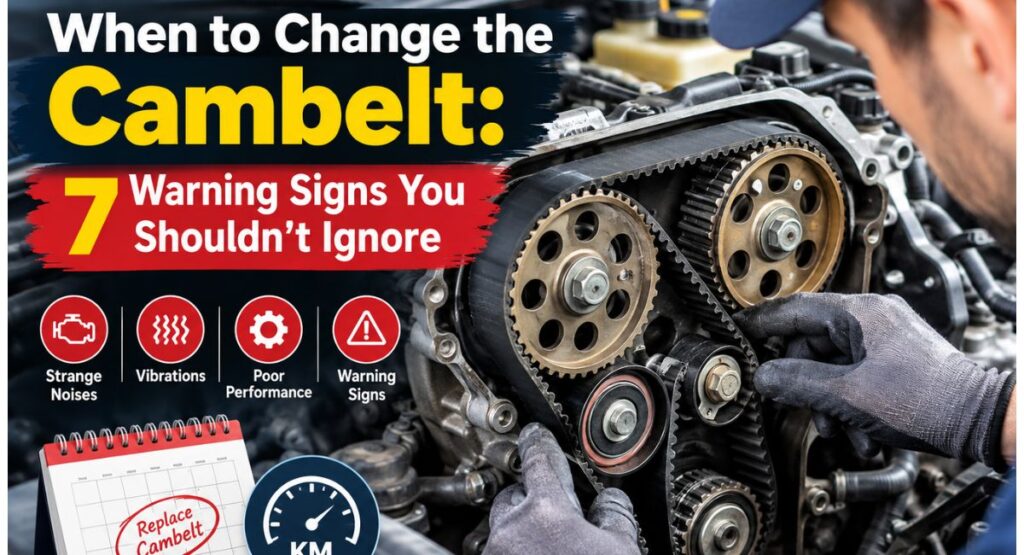
How to Know If Your Cambelt Needs Changing: 7 Warning Signs
1. A Ticking, Knocking, or Rattling Sound from the Timing Cover
This is very often the first sign, and it’s exactly the noise that caught out the customer in Leeds. It typically comes from a belt with missing or damaged teeth slipping slightly against the crankshaft or camshaft pulley, or from a tensioner that’s no longer holding correct pressure. The sound tends to be most noticeable at idle and can change pitch as engine revs rise. Any new noise from the front of the engine that wasn’t there before deserves an immediate look, not a “let’s see if it goes away.”
2. Engine Misfiring or Rough Running
When a cambelt begins to slip, even slightly, it throws off the precise relationship between valve timing and piston movement. The result is a rough, uneven idle, hesitation under acceleration, or a general sense that the engine has lost its usual smoothness. Drivers often describe this as the car feeling “off” before they can pinpoint exactly why — trust that instinct and get it checked.
3. Difficulty Starting or a Non-Start
If the belt has slipped a tooth on either sprocket, the engine’s compression timing is disrupted at the exact moment it matters most. You might notice longer-than-usual cranking before the engine catches, or in more advanced cases, the car simply won’t start at all. This is often mistaken for a battery or starter motor fault, so it’s worth ruling out the cambelt specifically if starting problems appear alongside any of the other signs on this list.
4. Squealing or Chirping Near the Timing Belt Tensioner
Distinct from the ticking sound above, a high-pitched squeal or chirp near the timing cover often points to a worn or seizing tensioner pulley rather than the belt itself. Since the tensioner and belt work as a system, a failing tensioner puts abnormal strain on an otherwise healthy belt, which is exactly why UK garages typically recommend replacing the tensioner and idler pulleys alongside the belt rather than in isolation.
5. Visible Cracking, Fraying, or Glazing on the Belt
If your specific engine allows a visual check without major disassembly, look for cracking across the belt’s ribs, fraying at the edges, missing teeth, or a shiny, glazed surface rather than a matte, slightly textured one. Any of these visible signs mean replacement shouldn’t wait for the next scheduled service, even if the engine still sounds and drives normally for now.
6. Oil Leaking from the Timing Cover Area
A leak specifically around the timing cover gasket can actually accelerate belt wear, since oil contamination degrades rubber compounds over time. If you spot oil pooling near the front-centre of the engine, treat it as two problems worth checking in the same visit: the leak itself, and whether it’s already begun affecting the belt’s condition.
7. The Engine Management Light Illuminates
On many modern vehicles, the engine’s computer can detect the kind of timing irregularity a slipping belt causes, triggering the engine management warning light on your dashboard. This won’t always specifically diagnose a cambelt issue on its own — a diagnostic code read is needed to confirm the cause — but combined with any of the six signs above, it’s a strong signal that timing-related trouble is already underway rather than just beginning.
Step-by-Step: What to Do If You Notice Any of These Signs
Step 1: Stop assuming it’s “probably nothing.” This is the single most common mistake — the customer in Leeds, and thousands like him, all start here.
Step 2: Check whether you know your cambelt’s service history. If you don’t know when it was last changed, or you bought the car used without clear records, treat any warning sign as higher priority rather than lower.
Step 3: Avoid unnecessary driving until it’s checked. Short trips to work are one thing; a long motorway journey with an unexplained knocking sound is a genuinely bad idea, particularly on an interference engine.
Step 4: Book an inspection with a garage that can check promptly. Explain the specific symptom clearly — the noise, when it happens, and any other signs you’ve noticed — since this helps the mechanic diagnose faster.
Step 5: Ask directly whether your engine is an interference design. This single fact should shape how urgently you treat the situation. On an interference engine, delaying isn’t just risky — it’s a gamble with your entire engine.
Step 6: If confirmed, replace the full belt kit, not just the belt. As covered above, a belt fitted without addressing a worn tensioner or idler pulleys is a common cause of early repeat failure.
A Special Case: Warning Signs on Wet Belt Engines
If you drive a Ford 1.0 EcoBoost or a PSA/Peugeot-Citroën 1.2 PureTech, the warning signs deserve extra attention, since these wet belt (belt-in-oil) engines have developed a pattern of earlier, less predictable failures than traditional dry cambelts. A few additional things worth watching for on these specific engines:
- Metallic particles or unusual debris in the oil when it’s changed, which can indicate belt material breaking down inside the oil system
- A noticeably different exhaust smell or increased oil consumption, sometimes linked to belt debris affecting other engine components
- Any of the seven signs above appearing well before the manufacturer’s stated interval, since these engines have a documented history of failing ahead of schedule
If you own one of these engines and notice anything unusual, it’s worth erring heavily on the side of caution rather than assuming you have years of interval left simply because the official figure says so.
Cambelt Replacement Recommendations by Make and Model (Including Honda)
Since intervals vary so much, it’s worth checking your specific make and model rather than assuming a universal number. A few commonly researched examples:
- When to change the cambelt Honda: Here’s an important accuracy point — most Hondas sold new in the UK today don’t actually have a cambelt at all. Honda switched the vast majority of its engines from belts to timing chains progressively between 2002 and 2006 (the Civic, CR-V, and Jazz all made the switch by 2006), and chain-equipped Honda engines have no scheduled replacement interval. If you own an older Honda from before that switch, or a V6 model that retained a belt slightly longer, check your specific engine code before assuming either way.
- Ford: Varies significantly by engine — some Ford engines use a conventional dry cambelt on a 10-year/100,000-mile interval, while the 1.0 EcoBoost uses the wet belt design covered above.
- Vauxhall/Peugeot/Citroën shared-platform engines: Many small-displacement engines shared across these brands specify intervals between 60,000 and 100,000 miles, though the wet belt caution above applies to several PureTech-based units regardless of badge.
Our companion interval guide has the fuller cost and mileage table if you want to check a wider range of manufacturers in one place.
Cam Belt vs Timing Belt: Is There Actually a Difference?
Short answer: no. Cam belt vs timing belt isn’t really a comparison of two different things — they’re simply two names for the exact same component, with “cambelt” being the more common term in the UK and “timing belt” the more common term in the US. Both refer to the reinforced rubber belt that synchronises the crankshaft and camshaft. If you’ve seen both terms used and wondered whether they describe different parts, you can stop wondering — they’re identical.
Cambelt vs Timing Chain: What Happens If a Cambelt Breaks?
This is one of the most important distinctions in this entire topic, so it’s worth spelling out clearly. A cambelt is rubber, requires scheduled replacement, and — on an interference engine — can cause serious internal damage if it snaps. A timing chain is metal, generally doesn’t require scheduled replacement, and typically lasts the life of the engine provided oil changes are kept up.
So, what happens if a cambelt breaks? On a non-interference engine, the engine simply stops — you’ll need a tow and a new belt, but the internals usually survive. On an interference engine, the outcome is far more serious: the pistons and valves, which briefly share the same space at different points in the engine’s cycle, can physically collide the instant the belt lets go. This typically bends valves, can damage pistons, and in more severe cases cracks the cylinder head — turning a scheduled few-hundred-pound job into a repair bill that can run into the thousands, sometimes approaching the value of the car itself.
The Real Cost of Ignoring These Signs
It’s worth putting a number next to this, since it makes the “just get it checked” advice easier to act on. A scheduled cambelt change in the UK typically costs £300 to £950, covered in full in our companion interval guide. Compare that to what happens if one of these seven signs is ignored until the belt actually fails on an interference engine: repair costs commonly run into the thousands, since bent valves, damaged pistons, and sometimes a cracked cylinder head are all realistic outcomes. The gap between “acted on a warning sign promptly” and “waited too long” is rarely subtle — it’s usually the difference between a scheduled bill and a potential write-off.
Why the Interference Engine Detail Changes Everything
It’s worth repeating this point clearly, since it’s the single biggest factor in how seriously to treat any sign on this list. On an interference engine — the large majority of modern cars — the pistons and valves share the same physical space at different points in the cycle. As long as the cambelt keeps everything synchronised, this is entirely safe. But the moment it slips or snaps, that timing collapses, and the piston and valve can physically collide.
On a non-interference engine, a failed belt simply stops the car — inconvenient, and requiring a tow, but the internals typically survive unharmed. Knowing which type you have fundamentally changes the calculation: on an interference engine, any one of the seven signs above deserves same-week attention, not “I’ll get to it eventually.”
Why It’s Worth Trusting a Reputable Garage With This Diagnosis
Diagnosing early cambelt trouble correctly takes genuine mechanical experience — several of these signs (ticking, squealing, rough running) can also point to entirely different, less serious issues, and an inexperienced diagnosis in either direction carries real cost. A garage with specific experience on your make and model, ideally AA or RAC approved, will be able to distinguish a genuine cambelt warning sign from something else far more reliably than guesswork at home. Ask them to explain exactly what they’re checking and why — a mechanic who understands this system well will always be able to walk you through their reasoning with confidence, rather than simply recommending a belt kit and moving on.
Final Thoughts
None of these seven signs are a substitute for knowing and following your manufacturer’s scheduled interval — that’s still the single most reliable way to avoid cambelt trouble altogether, and it’s covered in full in our companion guide on how often to replace your cambelt. But schedules get missed, service histories go missing on used cars, and belts occasionally fail early — which is exactly why knowing these seven signs, and treating them seriously the moment they appear, genuinely matters.
For the full technical picture of how this component works, see Timing Belt Explained: What Is a Timing Belt and What Does It Do?, and for everything else your car needs on schedule, our Complete Guide to Car Maintenance: What to Check and When covers it in full. The garage owner in Leeds put it best: “The car almost always tells you something’s wrong. Most people just aren’t listening yet.”
Frequently Asked Questions
How do you know a cam belt needs changing, and when?
There are two reliable ways to know, and the safest approach combines both. First, check your service history against your manufacturer’s specified interval — typically 4 to 10 years, or 40,000 to 100,000 miles, whichever comes first — since this is the primary way a cambelt is meant to be replaced, not by symptom. Second, watch for warning signs that can indicate trouble ahead of schedule: a ticking or knocking sound from the timing cover, rough idling or misfiring, difficulty starting, squealing near the tensioner, visible cracking or fraying on the belt if it’s accessible, oil leaking near the timing cover, or the engine management light illuminating. Remember, though, that the MOT does not check the cambelt, so a recent pass tells you nothing about its condition — the service history and these symptoms are genuinely the only reliable indicators you have.
How much does a cambelt cost to replace?
In the UK, typical cambelt replacement costs run from £300 to £950, with most jobs landing between £450 and £700 including parts and labour. The exact figure depends heavily on your specific make and model, since some engines are far more labour-intensive to access than others. Wet belt engines (like the Ford 1.0 EcoBoost or PSA/Peugeot-Citroën 1.2 PureTech) typically cost more — commonly £550 to £1,400 — since the job often involves cleaning oil galleries and the sump of belt debris, not just fitting a new belt. Most reputable garages recommend replacing the tensioner and idler pulleys alongside the belt, which adds to the cost but avoids paying for the same labour twice if those parts fail shortly after.
Will a timing belt last 200,000 miles?
Generally, no — not safely. Nearly every manufacturer’s recommended interval falls well short of 200,000 miles, typically topping out around 100,000 miles even for the longest-rated belts. While it’s technically possible for an individual belt to physically survive that long without failing, doing so means operating well past the point manufacturers consider an acceptable risk, and rubber compounds degrade with age and heat regardless of how carefully the car is driven. If you’re closing in on 200,000 miles without a scheduled belt replacement on record, take that as a clear cue to have it inspected and swapped out right away — don’t let the fact that it ‘hasn’t gone yet’ convince you everything’s fine.
How often should you replace a cam belt?
As a general rule, most manufacturers specify somewhere between 4 and 10 years, or 40,000 to 100,000 miles, whichever comes first — though the exact interval varies meaningfully by make and engine, so it’s always worth checking your specific vehicle handbook. A few common examples: many modern petrol and diesel engines sit around 5 years/60,000 miles, some older diesels and performance engines call for 4 years/40,000 miles, and certain newer long-life belts (some Ford and VAG Group engines) are rated for up to 10 years/100,000 miles. The time-based half of the interval matters just as much as the mileage — a belt that’s only covered a small number of miles over many years is still aging from heat cycles regardless of how little the car has been driven.
Can a timing belt last 10 years?
In terms of pure calendar time, some manufacturers do rate specific newer belts for up to 10 years — so yes, it’s possible, but only for those specific belts and only up to the manufacturer’s own stated limit. It’s not a general rule you should apply to any timing belt regardless of its actual rated interval. A 10-year figure on a belt only rated for 5 years, for instance, means you’re operating well outside the margin the manufacturer built in, and rubber degrades from age and heat cycling even on a car that’s barely been driven. Always check the specific interval for your exact make, model, and engine rather than assuming a 10-year belt is universal.
Are there warning signs before a timing belt breaks?
Usually, yes — outright failure with zero warning is relatively uncommon. Most timing belts show at least one symptom in the days, weeks, or occasionally months before complete failure: a ticking or knocking noise from the front of the engine, rough idling or misfiring, difficulty starting, squealing near the tensioner, visible cracking or fraying on the belt, or an oil leak nearby. That said, “usually” isn’t “always,” and once a belt is well past its recommended mileage or time interval, the risk of a sudden failure with little practical warning increases significantly. This is exactly why manufacturers set a scheduled replacement interval in the first place rather than relying on drivers to catch a symptom in time — the safest strategy combines watching for warning signs and respecting the mileage-based interval, rather than depending on either one alone.