How long does it take to change brake fluid? For most cars, the honest answer is somewhere between 30 and 90 minutes, which genuinely surprises a lot of drivers. A coworker of mine put off a brake fluid flush for three years because she’d mentally filed it under “big, expensive, all-day job,” right next to a transmission rebuild. When she finally asked her mechanic about it, he had her car back to her in under an hour, and the bill was smaller than a tank of gas plus lunch. “I avoided this for three years over nothing,” she told me, half laughing and half annoyed at herself.
That mix-up is more common than you’d think, so this guide covers seven things worth knowing about changing your brake fluid: how long it actually takes, why the fluid needs changing at all, what the process involves, and how to tell if yours is overdue. For the rest of your braking system, our companion guides on checking brake pads and spotting bad rotors cover those components in depth; this one is just about the fluid.
1. How Long Does a Brake Flush Take? (How Long to Replace Brake Fluid, Explained)
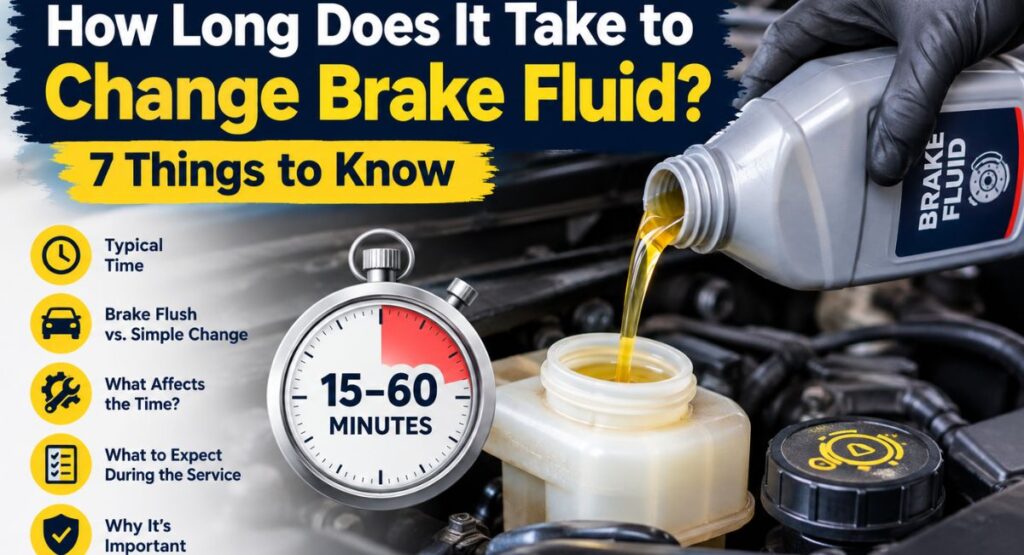
A standard brake fluid flush on a typical passenger car takes about 30 to 90 minutes, with most falling closer to 45 to 60 minutes. The exact time depends on your specific vehicle, whether the technician needs to bleed the ABS module separately (some systems require a special procedure or scan tool to fully cycle the ABS solenoids), and how accessible each brake line is. A simple sedan with straightforward brake lines sits at the faster end; an SUV, a performance car, or one with a complex ABS system sits toward the slower end.
If you’re getting it done alongside other brake work, like new pads or rotors, the flush usually adds very little extra time, since the car is already up on a lift with wheels off.
2. Why Brake Fluid Needs Changing At All
Unlike most fluids in your car, brake fluid doesn’t wear out from mileage or friction. It degrades because it’s hygroscopic, meaning it actively absorbs moisture from the air over time, even sitting untouched in a sealed system. According to AutoZone’s breakdown of brake fluid ratings, moisture contamination lowers the fluid’s boiling point significantly, and a fluid with a lower boiling point is more prone to vaporizing under the intense heat generated by hard or repeated braking.
When that happens, tiny vapor bubbles can form in the brake lines, and because those bubbles compress under pressure (unlike liquid fluid, which doesn’t), you can end up with a spongy pedal, less responsive right when you need firm, predictable braking the most.
3. DOT 3 vs. DOT 4: What’s the Difference, and Does It Matter?
Check your brake fluid reservoir cap, and you’ll likely see “DOT 3” or “DOT 4” stamped into the plastic. These ratings come from the U.S. Department of Transportation and describe how much heat the fluid can handle before it boils.
| Fluid Type | Dry Boiling Point | Wet Boiling Point |
|---|---|---|
| DOT 3 | 401°F (205°C) | 284°F (140°C) |
| DOT 4 | 446°F (230°C) | 311°F (155°C) |
| DOT 5.1 | 500°F (260°C) | 356°F (180°C) |
The dry boiling point is the figure for fresh, uncontaminated fluid; the wet boiling point is the figure once the fluid has absorbed a meaningful amount of moisture, which is exactly why that number is so much lower. DOT 4 has a higher starting boiling point and often includes additional additives for heat resistance, but here’s the counterintuitive part: DOT 4 can actually absorb moisture faster than DOT 3, meaning it sometimes needs changing just as often despite its higher starting number. Always use the type your manufacturer specifies, since mixing incompatible types (particularly silicone-based DOT 5) can cause real problems.
4. Signs Your Brake Fluid Is Overdue
You won’t always feel contaminated brake fluid right away, but a few signs are worth watching for:
- A soft or spongy brake pedal, especially one that seems to sink further than it used to.
- Dark, cloudy, or brown fluid in the reservoir, instead of the light amber color of fresh fluid.
- The ABS warning light illuminating, which can sometimes be linked to contaminated fluid affecting the system.
- Reduced or inconsistent braking performance, particularly after a long descent or repeated hard stops.
- An unusual smell or sound while braking, which can sometimes point to fluid-related issues in the system.
- Simply reaching the time-based interval, even if nothing feels wrong yet, since degradation happens quietly in the background.
5. How Long Does Brake Fluid Last in a Car? Is It Necessary Every Two Years?
Most manufacturers recommend a brake fluid flush every 2 to 3 years, or roughly every 30,000 to 45,000 miles, regardless of how the brakes feel. This is a case where mileage genuinely isn’t the deciding factor. Industry data on moisture absorption shows that a typical brake system can absorb about 2% of its fluid volume in moisture within just 12 months, and once DOT 3 fluid accumulates around 3% moisture, its boiling point can drop by roughly 25%. That’s a meaningful safety margin lost, even on a car that’s barely been driven.
Step-by-Step: What Happens During a Brake Fluid Flush
Step 1: The reservoir is checked and old fluid is inspected. The technician notes the fluid’s color and condition before starting, which helps confirm just how overdue the change actually was.
Step 2: A machine or manual bleeding process pushes fresh fluid through the system. Most shops use a pressure bleeder or vacuum bleeder that pushes new fluid in at the master cylinder while old fluid is pushed out at each wheel.
Step 3: Each wheel is bled in a specific sequence. This is typically done in an order specified by the manufacturer, usually starting with the wheel farthest from the master cylinder and working closer.
Step 4: The reservoir is topped off with the correct fluid type. Matching your manufacturer’s specified DOT rating matters here, not just “whatever’s on the shelf.”
Step 5: The ABS module is cycled, if needed. Some vehicles require a scan tool to fully cycle the ABS solenoids during the flush, ensuring no old fluid or air gets trapped in that part of the system.
Step 6: The pedal feel and fluid level are rechecked before the car leaves. A firm, consistent pedal with no sponginess confirms the job was done correctly and no air remains trapped in the lines.
6. Brake Fluid Change Cost: What a Flush Typically Runs
For most passenger vehicles, a professional brake fluid flush runs roughly $75 to $150, depending on your vehicle, the fluid type required, and local labor rates. Vehicles with more complex ABS systems, or those requiring a less common fluid type like DOT 5.1, tend to sit toward the higher end. This is genuinely one of the more affordable items on a car’s maintenance list, especially compared to the cost of brake system corrosion or component damage that can result from skipping it for years.
7. How Long Does It Take to Change Brake Fluid at Home? DIY vs. Shop
Technically, yes, and some confident DIYers do. It requires a brake bleeder kit (or a helper to pump the pedal while you work the bleeder valves), the correct fluid type, and patience, since getting all the air out of the lines takes a careful, methodical approach. That said, brakes are about as safety-critical as car maintenance gets, and a job done incorrectly, like trapped air left in the lines, directly affects your ability to stop. If you’re not fully confident in bleeding a brake system correctly, this is a reasonable one to leave to a professional, even if you handle other maintenance yourself.
Common Mistakes People Make With Brake Fluid
A few avoidable mistakes come up often enough to be worth flagging directly:
- Topping off instead of flushing. Adding a bit of fresh fluid to a low reservoir isn’t the same as replacing the old, moisture-contaminated fluid throughout the system. If your level is dropping, that’s also worth investigating, since brake fluid shouldn’t disappear on its own without a leak somewhere.
- Mixing incompatible fluid types. DOT 3, DOT 4, and DOT 5.1 are all glycol-based and generally compatible with each other, but DOT 5 silicone fluid is a completely different chemistry and should never be mixed in unless your manufacturer specifically calls for it.
- Leaving an opened bottle around for “next time.” Brake fluid starts absorbing moisture from the air the moment the seal is broken, so a half-used bottle sitting in the garage for a year is already degraded before it’s even gone in the car.
- Assuming a clear pedal feel means healthy fluid. Moisture contamination doesn’t always produce an obvious symptom until you’re under hard braking, which is precisely the moment you most need the fluid to perform.
- Ignoring the time-based interval because mileage is low. A car that’s barely driven still has fluid quietly absorbing moisture in the background, so the 2-to-3-year clock keeps running regardless of odometer reading.
Brake Fluid vs. Other Fluids: Don’t Get Them Confused
It’s worth a quick note here, since mix-ups do happen: brake fluid is not the same as power steering fluid, transmission fluid, or coolant, and using the wrong one in the wrong reservoir can cause serious damage. Brake fluid is specifically formulated to be compatible with the rubber seals and components throughout your brake system; other fluids are not, and introducing the wrong one can cause seals to swell or deteriorate. If you’re ever topping off a reservoir yourself, double-check the cap labeling and your owner’s manual before pouring anything in, since the various reservoirs under the hood aren’t always obviously distinguishable at a glance.
Why It’s Worth Using the Right Fluid and a Trusted Shop
This is a job where cutting corners genuinely isn’t worth the small savings. Using the wrong DOT rating, old fluid that’s absorbed moisture from sitting opened too long, or an inexperienced shop that doesn’t fully bleed the system can leave you with a spongy pedal or trapped air, undermining the exact safety margin a flush is supposed to restore. Choose a shop that uses fresh, sealed fluid matching your manufacturer’s specification, and don’t hesitate to ask whether they’re cycling the ABS module if your vehicle requires it. A shop that can answer that question clearly is one that takes this often-overlooked job as seriously as it deserves.
How Long Does a Brake Fluid Change Take on a Toyota or BMW?
Timing can shift depending on your specific vehicle, and two commonly searched examples show why.
Toyota: Most Toyota models have a straightforward hydraulic brake system without extra electronic steps, so a flush typically falls at the faster end of the general range, around 30 to 45 minutes, and is easily paired with a pad or rotor job during the same visit.
BMW: Many modern BMWs are a different story. Because of their ABS and DSC (Dynamic Stability Control) modules, a proper flush needs a specialized diagnostic scan tool to electronically cycle the ABS pump and valves and force out contaminated fluid trapped inside, a step that’s easy to skip but leaves the job incomplete if it is. BMW also recommends DOT 4 Low Viscosity (LV) fluid specifically, to protect those sensitive components. All of this typically adds time versus a simpler car, and many BMW owners also need the brake fluid service light reset afterward using the same scan tool, or through the iDrive trip-reset menu on models with Condition Based Service. If a shop is already doing other brake work, the fluid flush itself usually only adds another 20 to 30 minutes, since the car is already up and apart.
The lesson either way: a published “30 to 90 minute” range is a solid general estimate, but your specific make and the complexity of its ABS system is what moves you toward one end or the other.
Is a Brake Fluid Flush Really Necessary, or Is It a Waste of Money?
This is a fair question, and a common one, since brake fluid flushes sometimes get a reputation as an easy upsell. Here’s the honest answer: for most daily-driven cars, yes, it’s a genuinely necessary service, not a scam, and the reasoning holds up under scrutiny. Brake fluid is hygroscopic and absorbs moisture whether you drive the car or not, and that moisture measurably lowers the fluid’s boiling point and promotes internal corrosion in calipers, wheel cylinders, and the ABS unit over time, none of which announce themselves with an obvious symptom until something goes wrong.
That said, skepticism isn’t unreasonable either, and a couple of caveats are worth knowing. Some shops do push a flush more aggressively than the fluid’s actual condition justifies, which is exactly why testing the fluid’s moisture content first, something many shops can do quickly and cheaply, is a reasonable ask before agreeing to a flush “just because.” If your fluid tests below roughly 2 to 3% moisture and you’re not yet at the manufacturer’s time-based interval, it’s fair to hold off. But dismissing the service entirely as a waste of money ignores real, well-documented chemistry: moisture absorption is not a myth, and the cost of a flush is genuinely small next to the cost of brake system corrosion repairs down the line.
Final Thoughts
So, how long does it take to change brake fluid? In most cases, less time than a trip to the grocery store and back, for a cost that’s genuinely modest compared to almost anything else on your maintenance list. My coworker’s three years of needless avoidance is a pretty common story, and it’s an easy one to avoid once you know what the job actually involves.
For everything else your braking system needs, see our guides on checking brake pads and spotting bad rotors, and for the full maintenance picture, our Complete Guide to Car Maintenance: What to Check and When covers everything else on a regular schedule.A quick, affordable flush every couple of years is a small cost to pay for brakes that perform exactly as you’d expect, every single time.
Frequently Asked Questions:
How much should it cost to have brake fluid changed?
For most passenger vehicles, a professional brake fluid flush runs roughly $75 to $150, covering both parts and labor. Where you land in that range depends on a few factors: your specific vehicle, the fluid type required (DOT 3 and DOT 4 are generally cheaper than DOT 5.1 or specialty low-viscosity fluids some European brands require), and local labor rates. Vehicles with more complex ABS or electronic stability systems, like many modern BMWs, often sit toward the higher end since the job requires a specialized scan tool to fully cycle the system. If you’re already having other brake work done, like a pad or rotor replacement, adding a fluid flush to that same visit usually costs less than doing it as a standalone appointment, since much of the labor overlaps.
Is brake fluid difficult to change?
It’s moderately difficult, more so than a basic fluid top-off but less involved than something like a timing belt. The core challenge isn’t mechanical complexity so much as precision: you need to fully bleed air out of the entire brake system, working through each wheel in the correct sequence, without introducing new air bubbles along the way. A confident DIYer with a brake bleeder kit, the correct fluid, and patience can do a basic flush at home. It gets considerably harder on vehicles with electronic ABS or stability control modules that need to be cycled with a scan tool to fully flush out old fluid trapped inside, since skipping that step leaves the job incomplete even if the pedal feels fine afterward. Because brakes are a safety-critical system, this is one where “difficult” should be weighed against “how confident am I that I won’t leave air in the lines,” not just whether you own the right tools.
How much should it cost to get my brake fluid changed?
roughly $75 to $150 at most shops for a standard passenger vehicle, with the exact number shifting based on your car, the fluid type it requires, and whether any extra steps (like cycling an ABS module) are needed. It’s worth getting a quote that specifies the fluid type being used, since some shops charge more for manufacturer-specific fluids that aren’t optional substitutions.
How often should brake fluid need changing?
Most manufacturers recommend a flush every 2 to 3 years, or roughly every 30,000 to 45,000 miles, whichever comes first, though this is one of the few maintenance items where time matters more than mileage. Brake fluid is hygroscopic, meaning it absorbs moisture from the air continuously, even on a car that’s barely driven, so the clock keeps running regardless of how many miles are on the odometer. A typical brake system can absorb around 2% of its fluid volume in moisture within just a year, which is already enough to meaningfully lower the fluid’s boiling point. Always check your specific owner’s manual, since some manufacturers specify different intervals, and some BMW and European models recommend closer to every 2 years specifically due to how sensitive their ABS components are to contaminated fluid.
What are signs of bad brake fluid?
A handful of signs, individually or together, point to fluid that’s overdue:
A soft or spongy brake pedal, especially one sinking further than it used to
Dark, cloudy, or brown fluid in the reservoir instead of a light amber color
An ABS warning light on the dashboard, which can sometimes be linked to fluid contamination
Reduced or inconsistent braking performance, particularly after sustained hard braking or a long downhill stretch
An unusual smell or sound while braking
Simply reaching the 2-to-3-year interval, even if nothing feels obviously wrong, since degradation happens quietly in the background without always producing a clear symptom first
Is it safe to keep driving when brake fluid is running low?
You can drive a short distance, but treat a low brake fluid level as something to address immediately, not something to monitor casually. Unlike most fluids that simply get used up over time, brake fluid operates in a sealed, closed system and shouldn’t drop on its own. A noticeably low level almost always points to a leak somewhere in the system, or pads that have worn down enough that the calipers have extended further than normal (which can also lower the reservoir level as a normal side effect of wear). If the level is only slightly low and you’re not seeing a warning light or a soft pedal, it’s reasonable to get it checked soon. But if the pedal feels spongy, sinks to the floor, or a brake warning light is on, don’t continue driving normally, since this points to an active problem with your braking system’s hydraulic integrity rather than routine wear. Have it inspected before driving further.